By 10 Degrees Automotive | Corona and Surrounding Areas | 951.414.9423
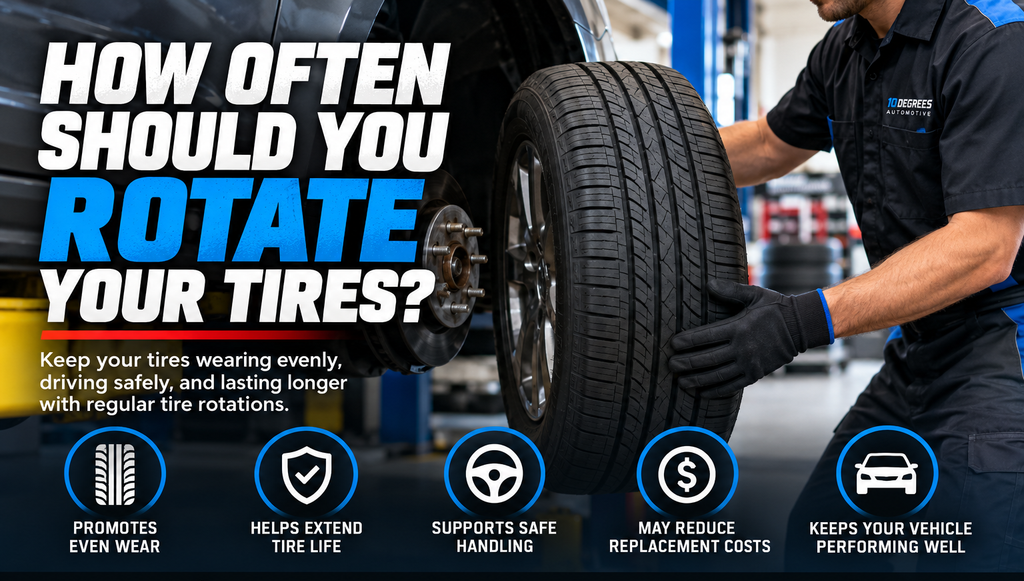
Your tires are among the most important safety components on your vehicle, providing the traction, stability, and control needed for everyday driving. Yet one of the simplest ways to protect your tires and extend their useful life is often overlooked: regular tire rotation. Whether you’re commuting along the 91 Freeway, traveling Interstate 15, or driving around Corona, maintaining even tire wear can help improve vehicle performance and reduce unnecessary replacement costs. At 10 Degrees Automotive, we help drivers throughout Corona and surrounding areas stay on top of essential tire maintenance services. If you’re wondering how often to rotate your tires, call 951.414.9423 to schedule a professional tire rotation service and keep your vehicle driving safely and smoothly.
🔄 What Is a Tire Rotation, and Why Is It Important?
A tire rotation involves moving your vehicle’s tires from one wheel position to another according to a recommended pattern.
Depending on your vehicle’s drivetrain, tire type, and wheel configuration, the tires may move from front to rear, side to side, or in a combination of these directions.
The purpose is to help distribute tire wear more evenly.
Your tires don’t all wear at the same rate because each wheel position experiences different forces during acceleration, braking, steering, and cornering.
For example, the front tires on many vehicles handle steering and a substantial portion of braking forces, which can contribute to faster wear.
Rotating the tires at appropriate intervals helps balance these differences.
Benefits of Regular Tire Rotation
- Promotes more even tread wear
- Helps maximize tire service life
- Supports consistent traction and handling
- May reduce premature tire replacement expenses
- Provides opportunities to identify tire damage
- Helps maintain balanced vehicle performance
- May support compliance with tire manufacturer warranty requirements
Although rotation cannot correct every tire problem, it remains an important part of preventative vehicle maintenance.
📅 How Often Should You Rotate Your Tires?
For many passenger vehicles, a common guideline is to schedule a tire rotation every 5,000 to 7,500 miles.
However, the correct interval depends on your vehicle manufacturer’s recommendations, tire specifications, drivetrain, and driving conditions.
Some vehicles require shorter intervals, while others may have different maintenance schedules.
General Tire Rotation Guidelines
| Vehicle Type | General Rotation Considerations |
|---|---|
| Front-wheel drive | Often every 5,000–7,500 miles |
| Rear-wheel drive | Often every 5,000–7,500 miles |
| All-wheel drive | Follow manufacturer guidance closely |
| Four-wheel-drive trucks | Depends on tire configuration and use |
| Electric vehicles | Follow vehicle-specific recommendations |
| Performance vehicles | Tire sizes and directional designs may restrict rotation |
These are general guidelines rather than universal requirements.
Always prioritize the maintenance schedule in your owner’s manual and the tire manufacturer’s instructions.
If you drive frequently in stop-and-go traffic, make sharp turns, carry heavy loads, or travel on rough roads, more frequent tire inspections may be beneficial.
🚗 Why Do Front and Rear Tires Wear Differently?
Tire wear depends on how vehicle weight and driving forces are distributed.
Front and rear tires perform different tasks depending on the vehicle’s design.
Front-Wheel-Drive Vehicles
On a front-wheel-drive vehicle, the front tires handle steering, engine power delivery, and much of the braking load.
Because they perform several demanding functions, the front tires may wear more quickly than the rear tires.
Rear-Wheel-Drive Vehicles
On a rear-wheel-drive vehicle, the rear tires transfer engine power to the road, while the front tires handle steering.
Different wear patterns can develop between the front and rear axles.
All-Wheel-Drive Vehicles
All-wheel-drive vehicles distribute power among multiple wheels, depending on the system.
Uneven tire wear can create differences in tire rolling circumference.
On certain AWD systems, excessive differences in tire circumference can place additional stress on drivetrain components.
This makes proper tire matching, inflation, tread depth monitoring, and rotation particularly important.
Electric Vehicles
Electric vehicles may place significant demands on their tires because of vehicle weight and immediate torque delivery.
Regenerative braking and vehicle-specific suspension characteristics can also influence wear patterns.
Regular inspection and rotation according to manufacturer recommendations help manage these conditions.
⚠️ Signs Your Tires May Need Rotation
Although mileage is the best starting point for scheduling tire rotation service, several warning signs may indicate uneven wear.
🛞 Uneven Tire Tread Wear
If the front tires appear more worn than the rear tires, rotation may help distribute future wear more evenly.
However, severe or irregular wear may require additional diagnosis.
🔊 Increased Tire Noise
Uneven tread patterns can sometimes produce humming or road noise.
A rotation may change the noise pattern, but persistent noise could indicate tire damage, wheel bearing problems, or suspension issues.
🚘 Changes in Vehicle Handling
Uneven tire wear can affect traction and handling characteristics.
If your vehicle feels unstable, pulls to one side, or responds differently during turns, have the tires and related components inspected.
📏 Noticeable Tread Depth Differences
Significant differences in tread depth between tire positions may indicate that rotations have been delayed.
A technician can measure tread depth and determine whether rotation is appropriate.
📋 Missed Maintenance Intervals
If you can’t remember your last tire rotation, checking your service records and inspecting the tires is a good idea.
Don’t wait for severe tire wear before scheduling maintenance. Preventative rotation works best when performed consistently.
🔧 What Tire Rotation Pattern Is Best?
Not every vehicle uses the same rotation pattern.
The appropriate pattern depends on drivetrain layout, tire construction, wheel sizes, and manufacturer requirements.
🔄 Forward Cross Pattern
<text weight=”medium”>Commonly used for certain front-wheel-drive vehicles with matching, non-directional tires.</text>
The rear tires move forward to opposite sides, while the front tires move straight back.
🔀 Rearward Cross Pattern
<text weight=”medium”>Commonly used for certain rear-wheel-drive and four-wheel-drive vehicles.</text>
The front tires move rearward to opposite sides, while the rear tires move straight forward.
↔️ Front-to-Rear Pattern
<text weight=”medium”>Often used with directional tires when front and rear tire sizes match.</text>
Tires remain on the same side of the vehicle and move between the front and rear axles.
❌ When Rotation May Be Restricted
Some vehicles have staggered wheel setups, meaning the front and rear tires are different sizes.
Other vehicles use directional tires that must rotate in a specified direction.
These configurations may limit or prevent conventional tire rotation.
A qualified technician can identify the correct pattern for your specific vehicle.
🛞 Can Tire Rotation Extend the Life of Your Tires?
Yes. Regular tire rotation can help extend tire life by reducing differences in wear between wheel positions.
When tires wear unevenly, one or two may reach their replacement limit before the others.
Consistent rotation can help distribute wear more evenly across the set.
However, rotation doesn’t reverse existing tread wear or repair damaged tires.
Tire longevity also depends on:
- Tire quality and construction
- Driving habits
- Road conditions
- Tire inflation pressure
- Wheel alignment
- Suspension condition
- Vehicle load
- Climate and temperature exposure
Proper rotation works best when combined with other preventative tire maintenance services.
⚖️ Tire Rotation vs. Wheel Alignment: What’s the Difference?
Drivers sometimes confuse tire rotation with wheel alignment, but these services serve different purposes.
| Service | Purpose |
|---|---|
| Tire rotation | Changes tire positions to distribute wear |
| Wheel alignment | Adjusts wheel angles to manufacturer specifications |
| Wheel balancing | Corrects uneven weight distribution in a wheel-and-tire assembly |
| Tire pressure adjustment | Maintains manufacturer-recommended inflation |
When Do You Need Wheel Alignment?
A wheel alignment may be necessary if your vehicle:
- Pulls to one side
- Has uneven tire wear
- Has a crooked steering wheel while traveling straight
- Recently experienced a significant pothole impact
- Has undergone certain suspension repairs
Rotating tires will not correct alignment-related wear.
If the underlying alignment problem remains, the tires may continue wearing unevenly even after rotation.
💨 Why Proper Tire Pressure Matters
Maintaining the correct tire pressure is just as important as rotating your tires.
Underinflated tires can generate excessive heat, increase rolling resistance, and wear unevenly.
Overinflated tires may also develop abnormal wear patterns and affect ride comfort.
How Often Should You Check Tire Pressure?
Check tire pressure at least once a month and before longer trips.
Measure pressure when the tires are cold, using the recommended inflation pressure listed on the vehicle’s tire information placard or in the owner’s manual.
Do not use the maximum pressure printed on the tire sidewall as the routine inflation target unless the vehicle manufacturer specifically directs it.
Proper inflation helps support:
- Consistent tire contact with the road
- Predictable vehicle handling
- Efficient tire performance
- Reduced abnormal tread wear
- Tire longevity
A tire rotation appointment is also an excellent opportunity to inspect inflation pressures and tire condition.
🚦 Does Driving Style Affect Tire Rotation Frequency?
Yes. Driving habits and road conditions can influence how quickly tires wear.
Aggressive Acceleration
Rapid acceleration can increase tire wear, particularly on driven wheels.
Hard Braking
Frequent aggressive braking places additional forces on tire tread.
Sharp Cornering
Taking turns at higher speeds increases lateral forces and may contribute to uneven shoulder wear.
Heavy Loads
Carrying heavy cargo or towing can increase demands on tires and suspension components.
Stop-and-Go Traffic
Frequent acceleration, braking, and turning during city driving can influence tire wear patterns.
Drivers who regularly experience demanding conditions may benefit from more frequent inspections and careful adherence to manufacturer maintenance schedules.
🧰 What Happens During a Professional Tire Rotation?
A professional tire rotation service involves more than simply moving tires between positions.
Depending on the vehicle and service requested, a technician may perform several important checks.
- Inspect tire condition: Look for cuts, punctures, bulges, cracking, and unusual wear.
- Measure tread depth: Compare tire wear between positions.
- Check tire pressure: Adjust inflation to appropriate manufacturer specifications.
- Identify tire configuration: Determine whether tires are directional, staggered, or otherwise restricted.
- Select the proper rotation pattern: Follow vehicle and tire manufacturer recommendations.
- Rotate the tires: Move eligible wheels to their designated positions.
- Torque wheel fasteners: Tighten lug nuts or bolts according to manufacturer specifications.
- Check tire monitoring requirements: Perform any applicable tire pressure monitoring system relearn or position update.
- Review findings: Identify potential alignment, suspension, or tire replacement concerns.
A professional inspection may reveal problems that aren’t obvious during everyday driving.
💰 How Much Does Tire Rotation Cost?
Tire rotation is generally one of the more affordable preventative automotive maintenance services.
The cost depends on the vehicle, wheel configuration, labor requirements, and whether additional services are included.
Some tire maintenance packages combine rotation with inspections or other routine services.
Factors that can affect pricing include:
- Vehicle size and configuration
- Wheel and tire specifications
- Tire pressure monitoring requirements
- Special wheel hardware
- Additional inspection or maintenance needs
Although tire rotation involves an upfront maintenance expense, preventing premature uneven wear can help reduce long-term tire replacement costs.
The best approach is to follow the recommended service schedule rather than waiting until the tires show severe wear.
❓ What Happens If You Never Rotate Your Tires?
Skipping tire rotations doesn’t guarantee immediate tire failure, but it can contribute to uneven wear and shortened tire life.
Potential consequences include:
- Front or rear tires wearing out prematurely
- Reduced consistency in traction
- Increased road noise from irregular wear
- More frequent tire replacement
- Difficulty maintaining balanced tire wear
- Potential tire warranty complications
- Greater tread depth differences on AWD vehicles
Tires with substantially different tread depths may also affect vehicle handling and, in certain drivetrain configurations, mechanical components.
Once tread wear becomes severe, rotating the tires may no longer be an appropriate solution.
In some cases, tire replacement is necessary.
🌡️ How Southern California Driving Conditions Affect Tires
Drivers throughout Corona and surrounding areas experience a combination of warm temperatures, freeway commuting, busy intersections, and changing road conditions.
Hot pavement can increase tire operating temperatures, particularly when tires are underinflated or overloaded.
Frequent commuting also adds mileage quickly, making it easy to overlook routine maintenance intervals.
Whether you’re driving through Corona, Norco, Eastvale, or Riverside, consistent tire inspections help identify developing problems.
Drivers who spend considerable time on the 91 Freeway or Interstate 15 may accumulate enough mileage to need rotations several times per year.
Keeping track of mileage and service history makes it easier to schedule maintenance before uneven wear becomes significant.
🛡️ Additional Ways to Extend Tire Life
Tire rotation is important, but it should be part of a broader tire care routine.
📏 Monitor Tread Depth
Check tread depth regularly.
In many jurisdictions, 2/32 of an inch is the legal minimum tread depth for passenger vehicle tires, but wet-weather traction can deteriorate significantly before that point.
Replacement may be advisable earlier depending on conditions and tire performance.
🔧 Maintain Proper Alignment
Misaligned wheels can cause rapid and uneven tire wear.
Have alignment checked when symptoms appear or after significant impacts.
💨 Maintain Correct Inflation
Check tire pressures monthly and adjust them according to manufacturer recommendations.
🚗 Drive Smoothly
Gradual acceleration, controlled braking, and moderate cornering can help reduce unnecessary tire wear.
🛞 Inspect Tires for Damage
Look for cuts, bulges, embedded objects, cracking, and unusual wear patterns.
📋 Keep Maintenance Records
Record tire rotations, tire purchases, and related maintenance services.
This helps you track service intervals and may be useful for applicable tire warranties.
📍 Tire Rotation Service in Corona and Surrounding Areas
Drivers throughout Corona, Norco, Eastvale, Riverside, and surrounding communities rely on dependable tires for daily transportation.
From busy freeway commutes to neighborhood errands and weekend road trips, proper tire maintenance contributes to vehicle safety and performance.
Whether you drive a sedan, SUV, pickup truck, or another passenger vehicle, keeping your tires properly inflated and regularly inspected helps protect your investment.
A professional tire maintenance inspection can identify uneven tread wear, potential alignment problems, and other conditions that may affect tire longevity.
Consistent maintenance is one of the simplest ways to reduce avoidable tire expenses and keep your vehicle operating smoothly.
❓ Frequently Asked Questions About Tire Rotation
Is rotating tires every 5,000 miles too often?
For many vehicles, 5,000 miles falls within a commonly recommended rotation interval. However, the manufacturer’s schedule should always take priority.
Can I rotate my tires every time I get an oil change?
Yes, if your oil change interval aligns with your vehicle’s recommended tire rotation schedule. Vehicles with longer oil change intervals may need tire rotations between oil services.
Do all-wheel-drive vehicles need tire rotation?
Yes, many AWD vehicles benefit from regular tire rotation. Maintaining similar tread depths and rolling circumferences can be particularly important for certain AWD systems.
Do new tires need to be rotated?
Yes. New tires should generally enter a regular rotation schedule according to vehicle and tire manufacturer recommendations.
Can tire rotation fix uneven tire wear?
Rotation can help manage future wear, but it cannot restore worn tread or correct underlying alignment, inflation, or suspension problems.
Do directional tires need rotation?
Yes, when the tire and wheel configuration permits it. Directional tires commonly rotate front to rear on the same side of the vehicle.
How long does a tire rotation take?
The time varies depending on the vehicle, equipment, and additional inspections. Many straightforward tire rotations can be completed relatively quickly.
Should I rotate tires before a long road trip?
If your vehicle is due for rotation, scheduling the service before a long trip is a good idea. A tire inspection can also help identify damage, low tread depth, or inflation concerns.
📞 Keep Your Tires Wearing Evenly and Your Vehicle Driving Smoothly
Regular tire rotation is a simple but valuable way to help extend tire life, maintain consistent handling, and reduce premature replacement costs. By following the recommended tire rotation interval and combining rotations with proper inflation, alignment checks, and routine inspections, you can help protect your tires through thousands of miles of everyday driving. At 10 Degrees Automotive, we help drivers throughout Corona and surrounding areas stay current with essential preventative vehicle maintenance and tire care services. Call 951.414.9423 today to schedule your next tire rotation service and keep your vehicle ready for the road ahead.