Tag: tire maintenance

  • ☀️ Summer Car Maintenance Tips for Southern California Drivers

    By 10 Degrees Automotive | Corona | 951.414.9423
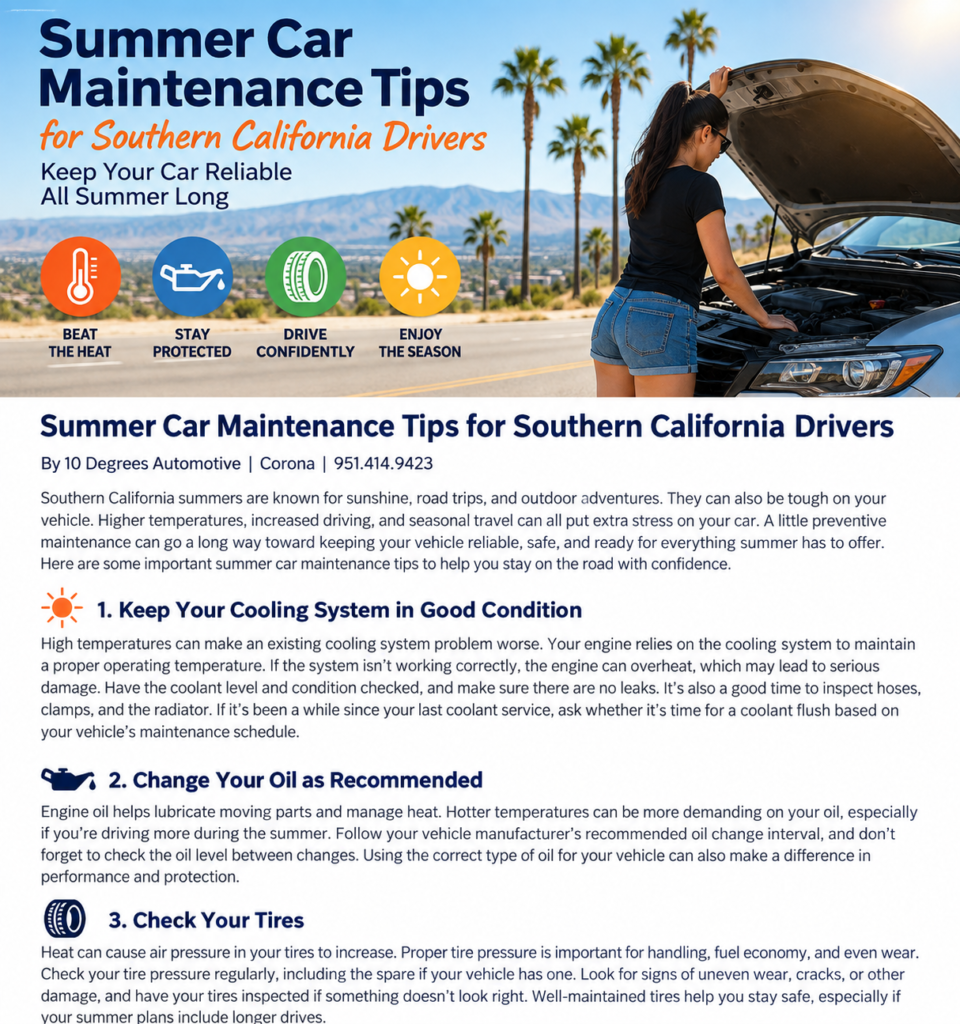
    Summer Car Maintenance Tips for Southern California Drivers

    Southern California summers can mean intense heat, long freeway drives, weekend road trips, and plenty of time behind the wheel. Those conditions can also put additional demands on your vehicle, making preventive maintenance especially important before temperatures climb. 10 Degrees Automotive in Corona can help drivers prepare their cars, trucks, and SUVs for summer driving with professional inspections, maintenance, and repairs. If you’re getting your vehicle ready for the heat or planning a summer road trip, call 951.414.9423 to schedule service.

    🌡️ 1. Pay Attention to Your Cooling System

    Your engine produces a tremendous amount of heat even under normal operating conditions. During hot summer weather, a cooling-system problem can become particularly troublesome.

    The engine cooling system is designed to maintain an appropriate operating temperature by circulating coolant through the engine and radiator.

    Low coolant, leaks, damaged hoses, radiator problems, thermostat issues, cooling-fan problems, and other faults can potentially contribute to overheating.

    Have the coolant level and condition checked as appropriate for your vehicle, and inspect the system for visible signs of leakage.

    Cooling-system maintenance should follow the manufacturer’s recommendations for your specific vehicle rather than relying on a universal schedule.

    🚨 2. Never Ignore an Overheating Engine

    If the temperature gauge moves unusually high or a temperature warning appears, take the situation seriously.

    Continuing to drive an overheating vehicle can potentially cause extensive engine damage.

    If you see steam coming from under the hood, don’t immediately open the radiator cap or cooling system. Hot coolant can be under pressure and may cause severe burns.

    Get to a safe location and shut the vehicle down when appropriate.

    An overheating problem needs diagnosis because simply adding coolant may not correct the underlying cause.

    The vehicle could have a leak, cooling-fan problem, thermostat issue, water-pump problem, radiator restriction, or another fault requiring repair.

    🛢️ 3. Keep Up With Oil Changes

    Engine oil plays a critical role in lubricating internal components and helping manage operating conditions inside the engine.

    Summer is a good time to check whether you’re approaching your next oil change.

    Follow the manufacturer’s recommended oil specification and maintenance interval for your vehicle.

    Don’t automatically assume every vehicle needs an oil change at the same mileage. Modern vehicles vary considerably in their requirements.

    If your dashboard includes an oil-life monitoring system, pay attention to it while also following the recommendations in your owner’s manual.

    Regular oil service is one of the fundamental parts of maintaining your engine throughout the year.

    🔍 4. Check the Engine Oil Level

    Oil changes aren’t the only time to think about engine oil.

    It’s also smart to periodically check the oil level, particularly before a long trip.

    Some engines consume a certain amount of oil between services, while leaks can cause the level to decrease unexpectedly.

    Running an engine with insufficient oil can result in serious problems.

    Check your owner’s manual for the proper procedure because it can vary by vehicle.

    If you discover that the oil level repeatedly drops between services, don’t simply continue topping it off indefinitely.

    Have the vehicle inspected to determine whether there is an oil leak or excessive oil consumption that needs attention.

    🔋 5. Have Your Battery Checked

    Drivers often associate battery trouble with cold weather, but summer heat can also be demanding on automotive batteries.

    High temperatures can accelerate battery deterioration.

    If your battery is several years old, the engine has begun cranking slowly, or you’ve recently needed a jump-start, consider having the battery tested.

    Look for obvious corrosion around the battery terminals and pay attention to any physical damage to the battery case.

    A battery that’s becoming weak may still start the vehicle today but fail when you least expect it.

    Testing before a summer trip can help identify a marginal battery before you’re stranded away from home.

    ⚡ 6. Don’t Forget the Alternator and Charging System

    A healthy battery still depends on a properly operating charging system.

    Once the engine is running, the alternator supplies electrical power and helps maintain battery charge.

    If the charging system develops a problem, the battery can eventually become discharged.

    Watch for warning signs such as a charging-system light, dim or flickering lights, unusual electrical behavior, or repeated dead-battery situations.

    Because battery and alternator symptoms can overlap, proper testing is more reliable than guessing which component has failed.

    ❄️ 7. Make Sure Your Air Conditioning Is Ready

    Few automotive problems become more obvious during a Southern California summer than weak air conditioning.

    If the vents aren’t blowing as cold as they used to, airflow is weak, cooling performance changes while idling, or the system makes unusual noises, have it inspected.

    Automotive air conditioning systems can experience problems involving refrigerant levels, leaks, compressors, condensers, fans, electrical components, controls, and other parts.

    Simply adding refrigerant isn’t always the correct solution.

    If refrigerant is low, there may be a leak that needs to be located.

    A properly diagnosed car AC problem can help you understand what actually needs repair.

    🛞 8. Check Tire Pressure Regularly

    Tire pressure changes with temperature, making tire maintenance particularly important when seasonal temperatures rise.

    Check pressure when the tires are cold and use the vehicle manufacturer’s recommended pressure.

    That specification is typically found on the tire-information placard inside the driver’s door area or in the owner’s manual.

    Don’t automatically inflate tires to the maximum pressure printed on the tire sidewall.

    The sidewall figure isn’t necessarily the correct operating pressure for your specific vehicle.

    Correct tire pressure contributes to proper handling, tire wear, and fuel efficiency.

    🔎 9. Inspect Your Tire Tread and Condition

    Pressure is only part of tire maintenance.

    Look at the tread and overall condition of each tire.

    Check for uneven wear, cuts, cracking, bulges, embedded objects, or other visible damage.

    Uneven wear can sometimes indicate alignment, suspension, inflation, or other problems.

    If your tires are approaching the end of their usable tread life, don’t wait until a long summer road trip to address them.

    Although Southern California summers may be dry, unexpected rain can still occur, and adequate tread is important when roads become wet.

    🔄 10. Rotate Your Tires When Recommended

    Regular tire rotation can help promote more even tread wear.

    The appropriate rotation interval and pattern depend on your vehicle and tire setup.

    Some vehicles use staggered tire sizes or directional tires that may limit how the tires can be rotated.

    Follow the applicable maintenance recommendations rather than assuming every vehicle uses the same rotation pattern.

    While the tires are being serviced, it’s also a convenient opportunity to inspect their condition and look for developing wear patterns.

    🛑 11. Have Your Brakes Inspected

    Summer road trips often mean freeway traffic, mountain drives, stop-and-go congestion, and additional miles.

    Your braking system needs to be ready.

    Possible brake warning signs include squealing, grinding, vibration, pulling, increased stopping distance, a soft or unusual brake pedal, or dashboard warning lights.

    Brake pads naturally wear over time, but other components can also require attention.

    Rotors, calipers, brake fluid, hoses, and other parts all contribute to braking performance.

    If something about the brakes feels or sounds different, don’t postpone an inspection simply because the vehicle still stops.

    💧 12. Check Important Vehicle Fluids

    Your vehicle may use several different fluids depending on its design.

    These can include engine coolant, brake fluid, transmission fluid, power steering fluid, windshield washer fluid, and differential or transfer-case fluids.

    Not every fluid is checked or serviced in the same way.

    Some modern transmissions, for example, have specific procedures for checking fluid condition and level.

    Follow manufacturer recommendations and have fluids inspected or serviced according to the vehicle’s requirements.

    If you notice fluid underneath your parked vehicle, don’t assume it’s harmless.

    Some condensation from the air conditioning can be normal, but colored, oily, or unusual fluid may indicate a leak.

    🚿 13. Keep Windshield Washer Fluid Filled

    Summer doesn’t eliminate the need for a clean windshield.

    Dust, insects, road grime, and other debris can quickly reduce visibility.

    Make sure the windshield washer reservoir has sufficient fluid and that the spray nozzles operate correctly.

    This is an inexpensive maintenance item that’s easy to overlook until you need it.

    Good visibility matters during daytime driving, but it can be especially important when dirt or residue on the windshield creates glare from direct sunlight or oncoming headlights.

    🌧️ 14. Inspect Your Windshield Wipers

    Southern California drivers can go long periods without using their windshield wipers, which makes it easy to forget about them.

    Heat and sun exposure can deteriorate rubber wiper blades over time.

    When rain finally arrives, worn blades may streak, chatter, or fail to clear the windshield effectively.

    Inspect your windshield wiper blades periodically and replace them if they’re damaged or no longer performing properly.

    Summer preparation isn’t only about hot, dry weather. It’s about making sure the vehicle is prepared for changing driving conditions.

    🌬️ 15. Check the Cabin Air Filter

    If airflow from your vents seems weaker than expected, a dirty cabin air filter may be one possible contributor.

    The cabin air filter helps filter air entering the passenger compartment through the climate-control system.

    Over time, it can collect dust, pollen, leaves, and other debris.

    Replacement intervals vary by vehicle and driving conditions.

    Drivers who frequently travel in dusty areas may need inspection more often.

    A clean filter is one part of maintaining effective HVAC airflow, although weak air conditioning can have many other causes that require diagnosis.

    🫁 16. Don’t Forget the Engine Air Filter

    Your engine also needs clean airflow.

    The engine air filter helps prevent dirt and debris from entering the engine’s intake system.

    A heavily restricted filter can affect performance.

    Instead of replacing it according to a random mileage rule, inspect and replace it based on the manufacturer’s maintenance guidance and actual condition.

    Dusty driving conditions can affect how quickly a filter becomes dirty.

    Checking it during routine summer maintenance is simple and can help ensure that an overlooked maintenance item doesn’t remain neglected.

    🧰 17. Inspect Belts and Hoses

    Rubber components under the hood operate in a challenging environment that includes heat and repeated temperature cycles.

    Hoses are particularly important to the cooling system, while drive belts may operate accessories and other components depending on the vehicle.

    Look for cracks, deterioration, leaks, fraying, glazing, swelling, or other visible damage.

    Not every belt or hose problem can be identified visually, but inspection is still worthwhile.

    A failed cooling-system hose on a hot summer afternoon can quickly turn an ordinary drive into an overheating situation.

    🚘 18. Prepare Before a Summer Road Trip

    If you’re planning a long drive, don’t wait until the night before departure to think about maintenance.

    Give yourself enough time to have the vehicle inspected and address any problems that are discovered.

    A pre-trip vehicle inspection might include checking tires, brakes, fluids, battery condition, cooling-system operation, belts, hoses, lights, wipers, and air conditioning.

    Also confirm that you’re up to date on scheduled maintenance.

    Preparing early is important because an inspection could uncover something that requires parts or additional repair time.

    It’s better to discover a worn component in the shop than hundreds of miles from home.

    🧳 19. Carry Basic Roadside Supplies

    Even a well-maintained vehicle can experience unexpected problems.

    Consider carrying practical roadside items such as drinking water, a flashlight, phone charging equipment, basic first-aid supplies, and appropriate emergency equipment.

    Make sure you know whether your vehicle has a spare tire, tire repair kit, or another manufacturer-provided solution.

    If it has a spare, check its condition and pressure periodically.

    It’s surprisingly common for drivers to discover a flat or unusable spare only after they need it.

    Roadside preparation becomes particularly important when traveling through remote or extremely hot areas.

    ⛽ 20. Pay Attention to Changes in Fuel Economy

    A noticeable decline in fuel economy can have many possible explanations.

    Tire pressure, driving style, heavy air-conditioning use, traffic conditions, maintenance issues, and mechanical problems can all affect fuel consumption.

    One unusual tank isn’t necessarily a reason for concern.

    However, if your vehicle consistently begins using significantly more fuel without an obvious change in driving conditions, it may be worth investigating.

    Changes in vehicle performance or fuel economy can sometimes provide an early clue that maintenance or repair is needed.

    ⚠️ 21. Don’t Ignore Dashboard Warning Lights

    Summer is not the time to begin a long road trip with unexplained warning lights illuminated.

    A check engine light, charging-system warning, temperature warning, oil-pressure warning, brake warning, or tire-pressure warning can indicate very different problems.

    Some warnings require more immediate action than others.

    Consult your owner’s manual and have significant or persistent warning lights properly diagnosed.

    Avoid assuming that a warning light can safely be ignored simply because the vehicle appears to drive normally.

    The warning may be the first indication of a developing problem.

    🅿️ 22. Heat Can Be Hard on a Parked Vehicle Too

    A vehicle doesn’t need to be moving to experience extreme temperatures.

    The passenger compartment can become dangerously hot when a car is parked in direct sunlight.

    Never leave children or pets unattended in a parked vehicle.

    Heat and sun can also affect interior surfaces and items stored inside the car.

    Whenever practical, parking in shade or using appropriate sun protection can help reduce direct solar exposure to the interior.

    Summer vehicle care includes protecting the car while driving and being aware of the conditions created while it’s parked.

    📅 23. Follow Your Vehicle’s Maintenance Schedule

    One of the most effective summer maintenance strategies is also one of the simplest: know what your vehicle is due for.

    Your owner’s manual contains maintenance information specific to your model.

    Depending on mileage, age, operating conditions, and vehicle design, scheduled service can include oil changes, filters, fluid services, spark plugs, inspections, and other maintenance items.

    Avoid relying entirely on generic maintenance schedules found online.

    Different vehicles can have significantly different requirements.

    Keeping records of completed services can also make it easier to know what needs attention next.

    🔧 24. Fix Small Problems Before Summer Heat Makes Them Bigger

    If your vehicle already has a small coolant leak, weak battery, worn tire, marginal air-conditioning system, or another developing problem, summer driving isn’t likely to make the inconvenience more enjoyable.

    Pay attention to changes in how your vehicle starts, sounds, smells, handles, stops, and operates.

    Unusual noises, leaks, vibrations, warning lights, or temperature changes deserve investigation.

    Preventive auto maintenance doesn’t mean replacing components unnecessarily. It means identifying legitimate maintenance needs and developing problems before they become larger or leave you stranded.

    ☀️ Get Your Vehicle Ready for Southern California Summer Driving

    Summer driving should be about getting where you want to go—not worrying whether your vehicle will survive the heat. Staying on top of cooling-system maintenance, oil changes, battery testing, air conditioning, tire care, brakes, fluids, belts, hoses, filters, and scheduled maintenance can help prepare your car for hot-weather driving and summer road trips. If you’d like your vehicle inspected or serviced before temperatures climb or before your next trip, contact 10 Degrees Automotive in Corona at 951.414.9423 to schedule professional automotive maintenance and repair.

  • 🚗 Preventive Car Maintenance: The Key to Avoiding Expensive Repairs

    By 10 Degrees Automotive | Corona | 951.414.9423

    Preventive Car Maintenance: The Key to Avoiding Expensive Repairs

    Most major automotive problems do not appear without warning. Long before an engine overheats, a transmission struggles, or a vehicle refuses to start, there are often small signs that maintenance is overdue. The challenge is that these early warnings can be easy to overlook—especially when your car still seems to run normally.

    That is why preventive car maintenance is one of the smartest investments a vehicle owner can make. Routine inspections and timely service help uncover minor concerns before they develop into major failures. They can also improve reliability, protect performance, support fuel efficiency, and help extend the useful life of your vehicle.

    At 10 Degrees Automotive in Corona, we help drivers take a proactive approach to vehicle care. Whether you need an oil change, fluid inspection, brake service, tire check, or a more complete maintenance evaluation, call 951.414.9423 to schedule an appointment.

    🔧 What Is Preventive Car Maintenance?

    Preventive maintenance is the routine care performed to keep a vehicle operating safely and efficiently. Instead of waiting for something to break, technicians inspect, test, replace, and service components according to the vehicle manufacturer’s recommendations and the car’s actual condition.

    A good vehicle maintenance plan may include:

    • Engine oil and filter changes
    • Fluid-level and fluid-condition checks
    • Brake inspections
    • Tire-pressure and tread checks
    • Battery and charging-system tests
    • Belt and hose inspections
    • Air-filter and cabin-filter replacement
    • Cooling-system service
    • Spark plug replacement
    • Wheel alignment and suspension checks

    The correct schedule depends on the vehicle’s year, make, model, mileage, engine, service history, and driving conditions. Your owner’s manual is the starting point, but a professional inspection can reveal whether a component needs attention sooner.

    💰 Small Services Can Help Prevent Large Repair Bills

    It is tempting to postpone maintenance when a vehicle appears to be working correctly. However, many systems depend on inexpensive fluids, filters, seals, and wearable components. When one of those items is neglected, it may place additional stress on much more costly parts.

    For example, old or insufficient engine oil may not lubricate and cool internal components effectively. A worn belt can fail and leave the vehicle disabled. Low coolant or a cooling-system leak may lead to overheating. Brake pads that wear too far can damage rotors and other braking components.

    Routine automotive maintenance cannot prevent every unexpected repair, but it can substantially reduce avoidable damage. Finding a small leak, weak battery, worn hose, or thinning brake pad early gives you more options. You may be able to schedule the work at a convenient time instead of dealing with a breakdown, tow, and urgent repair.

    🛢️ Keep Up With Oil and Filter Changes

    Engine oil lubricates moving parts, helps manage heat, suspends contaminants, and reduces internal friction. Over time, oil becomes contaminated and its protective qualities decline. The filter also collects debris and eventually becomes less effective.

    Following the recommended oil change interval is fundamental to engine care. The proper interval varies by vehicle and oil specification, so avoid relying on a universal mileage rule. Short trips, frequent idling, stop-and-go traffic, heavy loads, towing, and high temperatures may also affect the appropriate service schedule.

    During an oil service, it is also useful to look for leaks, unusual oil consumption, and changes in oil condition. Addressing these concerns early may help protect the engine from accelerated wear. If you are unsure when your vehicle is due, contact 10 Degrees Automotive at 951.414.9423.

    🌡️ Protect the Cooling System From Overheating

    Corona drivers know how demanding hot weather can be on a vehicle. The cooling system must regulate engine temperature even during summer heat, traffic, and extended driving. Coolant, the radiator, water pump, thermostat, hoses, reservoir, and cooling fans all play important roles.

    A small coolant leak can gradually lower the system level until the engine begins running too hot. A weak hose may burst, and contaminated or deteriorated coolant may not provide the protection the system needs.

    Warning signs of a possible cooling system problem include:

    • A rising temperature gauge
    • Coolant beneath the vehicle
    • A sweet odor near the engine
    • Steam from under the hood
    • Frequent need to add coolant
    • A dashboard temperature warning

    Never continue driving an overheating vehicle if it can be stopped safely. Severe overheating can cause extensive engine damage. A preventive cooling-system inspection can identify leaks and deteriorated components before the vehicle reaches that point.

    🛑 Do Not Wait for Brake Problems to Become Emergencies

    Brake components wear gradually, which means a driver can become accustomed to changes in braking feel. Routine brake inspections help measure wear and identify problems before stopping performance is compromised or related components are damaged.

    Possible warning signs include squealing, grinding, vibration, pulling, a soft brake pedal, longer stopping distances, or an illuminated brake warning light. Some noises can have several causes, so an inspection is the safest way to determine what is happening.

    Replacing worn brake pads at the appropriate time can help protect the rotors. Checking brake fluid and inspecting hydraulic components may also reveal contamination or leaks. Because brakes are essential to vehicle safety, unusual symptoms deserve prompt professional attention.

    🔋 Test the Battery Before It Leaves You Stranded

    Automotive batteries have a limited service life, and heat can accelerate internal deterioration. A battery may continue starting the vehicle until its remaining capacity becomes too low—sometimes with little notice.

    A car battery test can evaluate battery condition and help determine whether the charging system is operating properly. Slow cranking, dim lights, electrical irregularities, corrosion, or repeated jump-starts are reasons to schedule an inspection. The issue may involve the battery, alternator, starter, cables, or another electrical component.

    Testing these systems proactively is usually far more convenient than discovering a no-start condition before work, school, or an important appointment.

    🛞 Tires Affect Safety, Comfort, and Efficiency

    Your tires are the vehicle’s connection to the road. Proper inflation, adequate tread, rotation, balancing, and wheel alignment all influence handling and tire life.

    Underinflated tires may run hotter and wear unevenly. Overinflation can reduce the contact patch and contribute to irregular wear. Misalignment may cause pulling, an off-center steering wheel, or rapid wear along one edge of a tire.

    Check tire pressure when the tires are cold and follow the specification on the vehicle’s tire-information label—not the maximum pressure molded into the tire sidewall. Periodic tire maintenance can help improve predictable handling and identify damage before it becomes a roadside problem.

    💧 Fluids Are the Lifeblood of Your Vehicle

    Modern vehicles rely on several fluids to lubricate, cool, clean, transmit pressure, and protect components. Depending on the vehicle, these may include engine oil, coolant, brake fluid, transmission fluid, power-steering fluid, differential fluid, transfer-case fluid, and windshield-washer fluid.

    Fluid level is only part of the story. Condition, contamination, odor, and the presence of leaks also matter. A fluid that looks acceptable to an untrained eye may still be overdue based on time, mileage, or manufacturer requirements.

    Routine fluid inspections allow technicians to look for seepage, damaged seals, worn hoses, and changes that may point to a developing problem. Always use fluids that meet the specifications for your particular vehicle.

    🚨 Pay Attention to Dashboard Warning Lights

    Warning lights are part of the vehicle’s early-alert system. A check-engine light, battery light, oil-pressure warning, brake warning, temperature warning, or tire-pressure light should not be ignored.

    Some lights indicate a maintenance reminder, while others signal a problem that could become serious. A flashing check-engine light, oil-pressure warning, or overheating warning may require immediate action. Continuing to drive without understanding the warning could increase damage or create a safety risk.

    Professional vehicle diagnostics can retrieve fault information and guide further testing. A trouble code identifies the system where a fault was detected; it does not always identify the failed part by itself. Proper diagnosis helps avoid replacing components based on guesswork.

    📅 Build a Maintenance Schedule That Fits Your Vehicle

    The best maintenance plan is specific, consistent, and documented. Begin with the manufacturer’s schedule, then account for how you actually use the vehicle. Severe-service conditions may include repeated short trips, extensive idling, dusty environments, frequent stop-and-go driving, towing, or operating in extreme heat.

    Keep records of services, inspection results, mileage, and recommended follow-up work. These records make it easier to plan expenses, prevent duplicate work, and demonstrate that the vehicle has been cared for if you decide to sell it.

    A practical schedule should cover:

    1. Items due by mileage or time
    2. Wear items that require periodic inspection
    3. Repairs that should be handled soon
    4. Longer-term services you can budget for

    If your vehicle’s history is incomplete, a comprehensive inspection can establish a baseline. From there, you can prioritize safety and reliability without trying to perform every possible service at once.

    ✅ The Benefits Go Beyond Avoiding Repairs

    Preventive maintenance is often discussed as a way to save money, but the benefits are broader. A well-maintained vehicle may deliver more dependable starting, smoother operation, consistent braking, more predictable handling, and better comfort. It can also reduce the likelihood of missing work or disrupting family plans because of an avoidable breakdown.

    Maintenance provides information, too. Knowing the present condition of your brakes, tires, fluids, battery, and belts helps you make informed decisions. Instead of being surprised by several problems at once, you can plan and prioritize repairs based on safety, urgency, and budget.

    📞 Schedule Preventive Car Maintenance in Corona

    Waiting for a dashboard warning, unusual noise, fluid leak, or breakdown can turn a manageable service into a much larger repair. A proactive inspection helps you understand what your vehicle needs now, what can wait, and what should be monitored.

    Trust 10 Degrees Automotive in Corona for attentive, professional preventive car maintenance. Our team can evaluate your vehicle, explain any findings, and help you develop a service plan based on its condition and manufacturer recommendations.

    Call 951.414.9423 today to schedule your next maintenance appointment. Whether your vehicle is due for routine service or you simply want greater confidence before your next trip, 10 Degrees Automotive is ready to help keep you moving.

  • 💰 How Preventive Maintenance Saves Drivers Money

    By 10 Degrees Automotive | Corona | 951.414.9423

    How Preventive Maintenance Saves Drivers Money

    Many drivers think of vehicle maintenance as another expense competing for space in the monthly budget. It can be tempting to postpone an oil change, skip a fluid inspection, or ignore a small noise when the car still starts and gets you where you need to go.

    However, delaying routine service rarely eliminates the cost. In many cases, it allows a minor issue to develop into a larger and more expensive repair.

    Preventive vehicle maintenance helps drivers protect major components, improve reliability, reduce the likelihood of unexpected breakdowns, and get more useful life from their vehicles. It can also make transportation expenses easier to anticipate instead of leaving you with an emergency repair at the worst possible time.

    At 10 Degrees Automotive in Corona, we help drivers stay ahead of developing automotive problems. Call 951.414.9423 to schedule your next maintenance appointment.

    🔧 What Is Preventive Vehicle Maintenance?

    Preventive maintenance consists of inspections and services performed before a mechanical failure occurs. It is based on your vehicle manufacturer’s recommendations, current mileage, operating conditions, maintenance history, and the actual condition of the vehicle.

    Common preventive services include:

    • Engine-oil and filter changes
    • Tire-pressure checks and tire rotations
    • Brake inspections
    • Cooling-system inspections
    • Battery and charging-system tests
    • Fluid-level and condition checks
    • Air-filter and cabin-filter replacement
    • Belt and hose inspections
    • Wheel-alignment checks
    • Spark-plug replacement
    • Transmission service when recommended
    • Suspension and steering inspections

    The exact schedule differs from one vehicle to another. Always consult the owner’s manual and use recommendations appropriate for the specific year, make, model, engine, and driving conditions.

    🛢️ Regular Oil Changes Help Protect Your Engine

    Engine oil lubricates moving parts, reduces friction, carries heat away from critical areas, and helps control contaminants. As oil ages, it can become contaminated and lose some of its ability to protect the engine.

    Waiting too long between oil changes may contribute to:

    • Increased friction
    • Sludge and deposit formation
    • Accelerated internal wear
    • Reduced engine performance
    • Poor fuel economy
    • Overheating
    • Expensive engine damage

    An oil change is generally far less costly than repairing or replacing a damaged engine. Following the correct service interval and using the proper oil specification are basic but important ways to reduce long-term ownership costs.

    Routine appointments also give a technician an opportunity to notice leaks, damaged hoses, low fluids, or other developing concerns.

    🌡️ Cooling-System Maintenance Can Prevent Overheating

    Your engine produces significant heat. The cooling system controls its operating temperature using coolant, a radiator, thermostat, water pump, fans, hoses, and other components.

    A small coolant leak may initially leave only a few drops beneath the vehicle. If ignored, the coolant level can fall until the engine overheats.

    Overheating may lead to:

    • Cylinder-head damage
    • Head-gasket failure
    • Warped engine components
    • Internal engine damage
    • A roadside breakdown
    • Complete engine failure

    Inspecting the coolant level, fluid condition, hoses, radiator, and related components can identify problems before the temperature gauge moves into the red zone.

    If you notice a sweet odor, coolant beneath the vehicle, steam, or an unusually high temperature reading, contact 10 Degrees Automotive at 951.414.9423 promptly.

    🛑 Brake Inspections Can Reduce Repair Costs

    Brake pads are designed to wear and eventually require replacement. Timely service can help prevent worn pads from damaging more expensive components.

    When brake pads wear through their friction material, their metal backing plates may grind against the rotors. This can create excessive heat, deep scoring, vibration, and reduced braking performance.

    A routine brake inspection can identify:

    • Thin brake pads
    • Uneven wear
    • Damaged rotors
    • Sticking calipers
    • Fluid leaks
    • Worn hardware
    • Brake-hose problems

    Replacing worn pads before metal-on-metal contact occurs may help preserve serviceable rotors and protect other brake components.

    Preventive brake service is not only a financial decision. It helps maintain the predictable stopping performance needed to keep you and your passengers safe.

    🛞 Tire Maintenance Helps You Get More From Each Set

    Tires represent a significant vehicle expense. Incorrect pressure, poor alignment, lack of rotation, and worn suspension components can cause a set of tires to wear out much earlier than expected.

    A tire that is consistently underinflated may wear unevenly, generate excessive heat, and increase rolling resistance. Overinflation can also affect wear and handling.

    Regular tire maintenance may include:

    • Checking and adjusting inflation pressure
    • Inspecting tread depth
    • Looking for cracks, punctures, or bulges
    • Rotating tires as recommended
    • Checking wheel alignment
    • Inspecting steering and suspension components

    Catching an alignment problem early may prevent thousands of miles of accelerated tread wear. Routine rotations help distribute wear more evenly where appropriate for the vehicle and tire setup.

    Properly maintained tires can also support predictable handling and efficient vehicle operation.

    🔋 Battery Testing May Help Prevent a No-Start Emergency

    Car batteries frequently fail with little warning, especially when they are old, weakened, or exposed to high temperatures. Southern California heat can contribute to internal battery deterioration even if the vehicle seems to start normally.

    A preventive battery and charging-system test can evaluate:

    • Battery condition
    • Available starting power
    • Charging voltage
    • Terminal condition
    • Cable connections
    • Alternator performance
    • Starting-system behavior

    Discovering a weak battery during a scheduled appointment is usually more convenient than finding a vehicle that will not start before work, school, or an important appointment.

    Preventive testing may also reveal that the battery is healthy and that a starter, alternator, cable, or electrical issue is responsible for the symptoms. Accurate testing helps drivers avoid paying for parts they do not need.

    ⚙️ Fluid Maintenance Protects Expensive Components

    Your vehicle uses several fluids to lubricate, cool, clean, or transmit hydraulic pressure. Depending on its design, these may include engine oil, coolant, brake fluid, transmission fluid, differential fluid, and power-steering fluid.

    Fluids can deteriorate because of heat, moisture, contamination, oxidation, and normal use. Low fluid levels may indicate a leak or another mechanical concern.

    Neglected fluid can contribute to premature wear in expensive systems such as:

    • The engine
    • Transmission
    • Cooling system
    • Braking system
    • Differential
    • Power-steering system

    A fluid service should be based on the vehicle manufacturer’s specifications and the fluid’s condition. Avoid one-size-fits-all recommendations that do not account for the specific vehicle.

    At 10 Degrees Automotive, we can help you understand which services are due and which ones are not yet necessary.

    👂 Small Symptoms Can Reveal Larger Problems Early

    Preventive maintenance includes paying attention to changes in how your vehicle sounds, smells, feels, and performs.

    A faint squeal may indicate a worn belt. A slight pull may point to alignment, tire, brake, or suspension trouble. A small fluid spot may reveal a developing leak. A slow start may signal a weakening battery or electrical problem.

    Early warning signs can include:

    • Dashboard warning lights
    • New noises
    • Unusual odors
    • Fluid leaks
    • Vibration
    • Changes in braking
    • Reduced acceleration
    • Rough idling
    • Poor fuel economy
    • Difficult starting

    Addressing these symptoms early gives a technician a chance to correct the underlying issue before it affects additional parts.

    For example, replacing a deteriorating belt is generally more manageable than repairing damage caused after it breaks. Fixing a coolant leak is far less disruptive than dealing with an overheated engine.

    ⛽ A Well-Maintained Vehicle May Use Fuel More Efficiently

    Fuel economy is affected by traffic, driving habits, weather, load, tire design, and vehicle condition. Maintenance cannot eliminate every cause of poor mileage, but it can correct several mechanical factors that increase fuel consumption.

    Potential contributors include:

    • Underinflated tires
    • A contaminated air filter in applicable conditions
    • Worn spark plugs
    • Engine misfires
    • Faulty sensors
    • Brake drag
    • Wheel-alignment problems
    • Incorrect fluid specifications
    • Unresolved check engine warnings

    A small reduction in efficiency may not appear significant during one fill-up, but unnecessary fuel use can add up over months and years.

    Maintaining the engine, tires, brakes, and related systems helps the vehicle operate as efficiently as its condition and design allow.

    🚗 Preventive Maintenance Supports a Longer Vehicle Life

    Buying another vehicle can be one of a household’s largest expenses. Extending the useful life of a dependable car may delay the need for another purchase, loan, registration expense, and higher insurance costs.

    Vehicles that receive consistent maintenance are more likely to reach higher mileage without avoidable mechanical damage. This does not mean every component will last forever, but routine care can help major systems provide their intended service life.

    Preventive maintenance may protect:

    • Engine components
    • Transmission components
    • Cooling-system parts
    • Steering and suspension systems
    • Brakes and rotors
    • Tires
    • Electrical components
    • Emissions equipment

    A well-documented maintenance history can also make the vehicle easier to evaluate when you eventually sell or trade it.

    📋 Maintenance Records Help You Avoid Duplicate Services

    Keeping accurate records is another way preventive maintenance can save money.

    A maintenance history helps you track:

    • When the oil was changed
    • When tires were rotated
    • Which filters were replaced
    • When brake service was performed
    • Which fluids were serviced
    • What repairs have already been completed
    • Which recommendations should be monitored

    Without records, drivers may repeat a service too soon or forget one until long after it was due.

    Keep invoices, note the mileage and date of each service, and maintain a copy of major repair information. Clear records can also help technicians identify patterns and make better-informed recommendations.

    📅 Planned Maintenance Is Easier to Budget For

    An unexpected repair bill can disrupt a household budget. Preventive care turns at least part of vehicle ownership into a planned expense.

    When you know that tires, brakes, fluids, or scheduled services are approaching, you may have time to prepare financially. You can ask questions, understand priorities, and plan the work instead of making decisions during a roadside emergency.

    A trusted repair shop can help separate recommendations into categories such as:

    • Safety concerns that need immediate attention
    • Maintenance that is currently due
    • Developing issues to monitor
    • Services likely to be needed later

    This information allows you to make informed decisions without assuming that every recommendation must happen at the same time.

    🚨 Preventive Maintenance Cannot Prevent Every Repair

    Even a carefully maintained vehicle can experience an unexpected component failure. Parts age, electronics fail, road hazards cause damage, and manufacturing defects can occur.

    Preventive maintenance is not a guarantee that nothing will ever break. Its purpose is to reduce avoidable problems, detect developing concerns, and give important components the conditions they need to operate properly.

    It can also help a technician distinguish normal wear from unusual wear. That difference is valuable because unusual wear may point to another condition that should be corrected.

    ✅ Simple Ways to Reduce Long-Term Vehicle Expenses

    Drivers can support their vehicles and budgets by following several practical habits:

    • Read the owner’s manual
    • Follow the appropriate maintenance schedule
    • Check tire pressure regularly
    • Respond to dashboard warning lights
    • Investigate new noises and leaks
    • Avoid driving an overheating vehicle
    • Schedule routine brake inspections
    • Keep accurate service records
    • Use the correct fluids and replacement parts
    • Work with a trusted automotive repair professional

    The key is consistency. Small services completed at the right time can help prevent larger problems later.

    🔧 Schedule Preventive Maintenance in Corona

    Preventive maintenance saves money by protecting major components, reducing secondary damage, extending tire and brake life, supporting fuel efficiency, and lowering the risk of emergency repairs.

    Most importantly, it helps keep your vehicle reliable enough for work, school, appointments, errands, and family travel.

    If you need preventive automotive maintenance in Corona, contact 10 Degrees Automotive. We can inspect your vehicle, review its maintenance needs, and help you prioritize the services that matter most.

    Call 951.414.9423 today to schedule an appointment with 10 Degrees Automotive. Investing in routine care now can help you avoid paying for preventable repairs later.