
Tag: Southern California car maintenance

  • β˜€οΈ Summer Car Maintenance Tips for Southern California Drivers

    By 10 Degrees Automotive | Corona | 951.414.9423
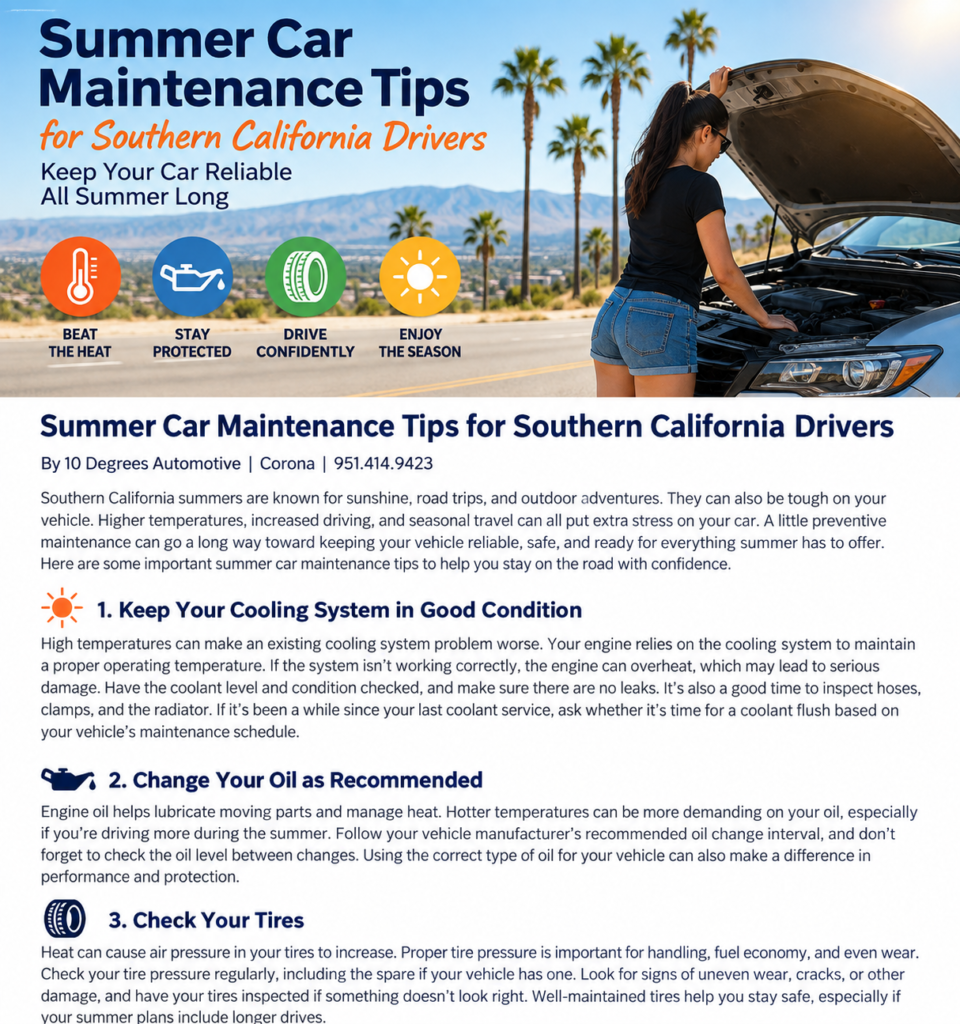
    Summer Car Maintenance Tips for Southern California Drivers

    Southern California summers can mean intense heat, long freeway drives, weekend road trips, and plenty of time behind the wheel. Those conditions can also put additional demands on your vehicle, making preventive maintenance especially important before temperatures climb. 10 Degrees Automotive in Corona can help drivers prepare their cars, trucks, and SUVs for summer driving with professional inspections, maintenance, and repairs. If you’re getting your vehicle ready for the heat or planning a summer road trip, call 951.414.9423 to schedule service.

    🌑️ 1. Pay Attention to Your Cooling System

    Your engine produces a tremendous amount of heat even under normal operating conditions. During hot summer weather, a cooling-system problem can become particularly troublesome.

    The engine cooling system is designed to maintain an appropriate operating temperature by circulating coolant through the engine and radiator.

    Low coolant, leaks, damaged hoses, radiator problems, thermostat issues, cooling-fan problems, and other faults can potentially contribute to overheating.

    Have the coolant level and condition checked as appropriate for your vehicle, and inspect the system for visible signs of leakage.

    Cooling-system maintenance should follow the manufacturer’s recommendations for your specific vehicle rather than relying on a universal schedule.

    🚨 2. Never Ignore an Overheating Engine

    If the temperature gauge moves unusually high or a temperature warning appears, take the situation seriously.

    Continuing to drive an overheating vehicle can potentially cause extensive engine damage.

    If you see steam coming from under the hood, don’t immediately open the radiator cap or cooling system. Hot coolant can be under pressure and may cause severe burns.

    Get to a safe location and shut the vehicle down when appropriate.

    An overheating problem needs diagnosis because simply adding coolant may not correct the underlying cause.

    The vehicle could have a leak, cooling-fan problem, thermostat issue, water-pump problem, radiator restriction, or another fault requiring repair.

    πŸ›’οΈ 3. Keep Up With Oil Changes

    Engine oil plays a critical role in lubricating internal components and helping manage operating conditions inside the engine.

    Summer is a good time to check whether you’re approaching your next oil change.

    Follow the manufacturer’s recommended oil specification and maintenance interval for your vehicle.

    Don’t automatically assume every vehicle needs an oil change at the same mileage. Modern vehicles vary considerably in their requirements.

    If your dashboard includes an oil-life monitoring system, pay attention to it while also following the recommendations in your owner’s manual.

    Regular oil service is one of the fundamental parts of maintaining your engine throughout the year.

    πŸ” 4. Check the Engine Oil Level

    Oil changes aren’t the only time to think about engine oil.

    It’s also smart to periodically check the oil level, particularly before a long trip.

    Some engines consume a certain amount of oil between services, while leaks can cause the level to decrease unexpectedly.

    Running an engine with insufficient oil can result in serious problems.

    Check your owner’s manual for the proper procedure because it can vary by vehicle.

    If you discover that the oil level repeatedly drops between services, don’t simply continue topping it off indefinitely.

    Have the vehicle inspected to determine whether there is an oil leak or excessive oil consumption that needs attention.

    πŸ”‹ 5. Have Your Battery Checked

    Drivers often associate battery trouble with cold weather, but summer heat can also be demanding on automotive batteries.

    High temperatures can accelerate battery deterioration.

    If your battery is several years old, the engine has begun cranking slowly, or you’ve recently needed a jump-start, consider having the battery tested.

    Look for obvious corrosion around the battery terminals and pay attention to any physical damage to the battery case.

    A battery that’s becoming weak may still start the vehicle today but fail when you least expect it.

    Testing before a summer trip can help identify a marginal battery before you’re stranded away from home.

    ⚑ 6. Don’t Forget the Alternator and Charging System

    A healthy battery still depends on a properly operating charging system.

    Once the engine is running, the alternator supplies electrical power and helps maintain battery charge.

    If the charging system develops a problem, the battery can eventually become discharged.

    Watch for warning signs such as a charging-system light, dim or flickering lights, unusual electrical behavior, or repeated dead-battery situations.

    Because battery and alternator symptoms can overlap, proper testing is more reliable than guessing which component has failed.

    ❄️ 7. Make Sure Your Air Conditioning Is Ready

    Few automotive problems become more obvious during a Southern California summer than weak air conditioning.

    If the vents aren’t blowing as cold as they used to, airflow is weak, cooling performance changes while idling, or the system makes unusual noises, have it inspected.

    Automotive air conditioning systems can experience problems involving refrigerant levels, leaks, compressors, condensers, fans, electrical components, controls, and other parts.

    Simply adding refrigerant isn’t always the correct solution.

    If refrigerant is low, there may be a leak that needs to be located.

    A properly diagnosed car AC problem can help you understand what actually needs repair.

    πŸ›ž 8. Check Tire Pressure Regularly

    Tire pressure changes with temperature, making tire maintenance particularly important when seasonal temperatures rise.

    Check pressure when the tires are cold and use the vehicle manufacturer’s recommended pressure.

    That specification is typically found on the tire-information placard inside the driver’s door area or in the owner’s manual.

    Don’t automatically inflate tires to the maximum pressure printed on the tire sidewall.

    The sidewall figure isn’t necessarily the correct operating pressure for your specific vehicle.

    Correct tire pressure contributes to proper handling, tire wear, and fuel efficiency.

    πŸ”Ž 9. Inspect Your Tire Tread and Condition

    Pressure is only part of tire maintenance.

    Look at the tread and overall condition of each tire.

    Check for uneven wear, cuts, cracking, bulges, embedded objects, or other visible damage.

    Uneven wear can sometimes indicate alignment, suspension, inflation, or other problems.

    If your tires are approaching the end of their usable tread life, don’t wait until a long summer road trip to address them.

    Although Southern California summers may be dry, unexpected rain can still occur, and adequate tread is important when roads become wet.

    πŸ”„ 10. Rotate Your Tires When Recommended

    Regular tire rotation can help promote more even tread wear.

    The appropriate rotation interval and pattern depend on your vehicle and tire setup.

    Some vehicles use staggered tire sizes or directional tires that may limit how the tires can be rotated.

    Follow the applicable maintenance recommendations rather than assuming every vehicle uses the same rotation pattern.

    While the tires are being serviced, it’s also a convenient opportunity to inspect their condition and look for developing wear patterns.

    πŸ›‘ 11. Have Your Brakes Inspected

    Summer road trips often mean freeway traffic, mountain drives, stop-and-go congestion, and additional miles.

    Your braking system needs to be ready.

    Possible brake warning signs include squealing, grinding, vibration, pulling, increased stopping distance, a soft or unusual brake pedal, or dashboard warning lights.

    Brake pads naturally wear over time, but other components can also require attention.

    Rotors, calipers, brake fluid, hoses, and other parts all contribute to braking performance.

    If something about the brakes feels or sounds different, don’t postpone an inspection simply because the vehicle still stops.

    πŸ’§ 12. Check Important Vehicle Fluids

    Your vehicle may use several different fluids depending on its design.

    These can include engine coolant, brake fluid, transmission fluid, power steering fluid, windshield washer fluid, and differential or transfer-case fluids.

    Not every fluid is checked or serviced in the same way.

    Some modern transmissions, for example, have specific procedures for checking fluid condition and level.

    Follow manufacturer recommendations and have fluids inspected or serviced according to the vehicle’s requirements.

    If you notice fluid underneath your parked vehicle, don’t assume it’s harmless.

    Some condensation from the air conditioning can be normal, but colored, oily, or unusual fluid may indicate a leak.

    🚿 13. Keep Windshield Washer Fluid Filled

    Summer doesn’t eliminate the need for a clean windshield.

    Dust, insects, road grime, and other debris can quickly reduce visibility.

    Make sure the windshield washer reservoir has sufficient fluid and that the spray nozzles operate correctly.

    This is an inexpensive maintenance item that’s easy to overlook until you need it.

    Good visibility matters during daytime driving, but it can be especially important when dirt or residue on the windshield creates glare from direct sunlight or oncoming headlights.

    🌧️ 14. Inspect Your Windshield Wipers

    Southern California drivers can go long periods without using their windshield wipers, which makes it easy to forget about them.

    Heat and sun exposure can deteriorate rubber wiper blades over time.

    When rain finally arrives, worn blades may streak, chatter, or fail to clear the windshield effectively.

    Inspect your windshield wiper blades periodically and replace them if they’re damaged or no longer performing properly.

    Summer preparation isn’t only about hot, dry weather. It’s about making sure the vehicle is prepared for changing driving conditions.

    🌬️ 15. Check the Cabin Air Filter

    If airflow from your vents seems weaker than expected, a dirty cabin air filter may be one possible contributor.

    The cabin air filter helps filter air entering the passenger compartment through the climate-control system.

    Over time, it can collect dust, pollen, leaves, and other debris.

    Replacement intervals vary by vehicle and driving conditions.

    Drivers who frequently travel in dusty areas may need inspection more often.

    A clean filter is one part of maintaining effective HVAC airflow, although weak air conditioning can have many other causes that require diagnosis.

    🫁 16. Don’t Forget the Engine Air Filter

    Your engine also needs clean airflow.

    The engine air filter helps prevent dirt and debris from entering the engine’s intake system.

    A heavily restricted filter can affect performance.

    Instead of replacing it according to a random mileage rule, inspect and replace it based on the manufacturer’s maintenance guidance and actual condition.

    Dusty driving conditions can affect how quickly a filter becomes dirty.

    Checking it during routine summer maintenance is simple and can help ensure that an overlooked maintenance item doesn’t remain neglected.

    🧰 17. Inspect Belts and Hoses

    Rubber components under the hood operate in a challenging environment that includes heat and repeated temperature cycles.

    Hoses are particularly important to the cooling system, while drive belts may operate accessories and other components depending on the vehicle.

    Look for cracks, deterioration, leaks, fraying, glazing, swelling, or other visible damage.

    Not every belt or hose problem can be identified visually, but inspection is still worthwhile.

    A failed cooling-system hose on a hot summer afternoon can quickly turn an ordinary drive into an overheating situation.

    🚘 18. Prepare Before a Summer Road Trip

    If you’re planning a long drive, don’t wait until the night before departure to think about maintenance.

    Give yourself enough time to have the vehicle inspected and address any problems that are discovered.

    A pre-trip vehicle inspection might include checking tires, brakes, fluids, battery condition, cooling-system operation, belts, hoses, lights, wipers, and air conditioning.

    Also confirm that you’re up to date on scheduled maintenance.

    Preparing early is important because an inspection could uncover something that requires parts or additional repair time.

    It’s better to discover a worn component in the shop than hundreds of miles from home.

    🧳 19. Carry Basic Roadside Supplies

    Even a well-maintained vehicle can experience unexpected problems.

    Consider carrying practical roadside items such as drinking water, a flashlight, phone charging equipment, basic first-aid supplies, and appropriate emergency equipment.

    Make sure you know whether your vehicle has a spare tire, tire repair kit, or another manufacturer-provided solution.

    If it has a spare, check its condition and pressure periodically.

    It’s surprisingly common for drivers to discover a flat or unusable spare only after they need it.

    Roadside preparation becomes particularly important when traveling through remote or extremely hot areas.

    β›½ 20. Pay Attention to Changes in Fuel Economy

    A noticeable decline in fuel economy can have many possible explanations.

    Tire pressure, driving style, heavy air-conditioning use, traffic conditions, maintenance issues, and mechanical problems can all affect fuel consumption.

    One unusual tank isn’t necessarily a reason for concern.

    However, if your vehicle consistently begins using significantly more fuel without an obvious change in driving conditions, it may be worth investigating.

    Changes in vehicle performance or fuel economy can sometimes provide an early clue that maintenance or repair is needed.

    ⚠️ 21. Don’t Ignore Dashboard Warning Lights

    Summer is not the time to begin a long road trip with unexplained warning lights illuminated.

    A check engine light, charging-system warning, temperature warning, oil-pressure warning, brake warning, or tire-pressure warning can indicate very different problems.

    Some warnings require more immediate action than others.

    Consult your owner’s manual and have significant or persistent warning lights properly diagnosed.

    Avoid assuming that a warning light can safely be ignored simply because the vehicle appears to drive normally.

    The warning may be the first indication of a developing problem.

    πŸ…ΏοΈ 22. Heat Can Be Hard on a Parked Vehicle Too

    A vehicle doesn’t need to be moving to experience extreme temperatures.

    The passenger compartment can become dangerously hot when a car is parked in direct sunlight.

    Never leave children or pets unattended in a parked vehicle.

    Heat and sun can also affect interior surfaces and items stored inside the car.

    Whenever practical, parking in shade or using appropriate sun protection can help reduce direct solar exposure to the interior.

    Summer vehicle care includes protecting the car while driving and being aware of the conditions created while it’s parked.

    πŸ“… 23. Follow Your Vehicle’s Maintenance Schedule

    One of the most effective summer maintenance strategies is also one of the simplest: know what your vehicle is due for.

    Your owner’s manual contains maintenance information specific to your model.

    Depending on mileage, age, operating conditions, and vehicle design, scheduled service can include oil changes, filters, fluid services, spark plugs, inspections, and other maintenance items.

    Avoid relying entirely on generic maintenance schedules found online.

    Different vehicles can have significantly different requirements.

    Keeping records of completed services can also make it easier to know what needs attention next.

    πŸ”§ 24. Fix Small Problems Before Summer Heat Makes Them Bigger

    If your vehicle already has a small coolant leak, weak battery, worn tire, marginal air-conditioning system, or another developing problem, summer driving isn’t likely to make the inconvenience more enjoyable.

    Pay attention to changes in how your vehicle starts, sounds, smells, handles, stops, and operates.

    Unusual noises, leaks, vibrations, warning lights, or temperature changes deserve investigation.

    Preventive auto maintenance doesn’t mean replacing components unnecessarily. It means identifying legitimate maintenance needs and developing problems before they become larger or leave you stranded.

    β˜€οΈ Get Your Vehicle Ready for Southern California Summer Driving

    Summer driving should be about getting where you want to goβ€”not worrying whether your vehicle will survive the heat. Staying on top of cooling-system maintenance, oil changes, battery testing, air conditioning, tire care, brakes, fluids, belts, hoses, filters, and scheduled maintenance can help prepare your car for hot-weather driving and summer road trips. If you’d like your vehicle inspected or serviced before temperatures climb or before your next trip, contact 10 Degrees Automotive in Corona at 951.414.9423 to schedule professional automotive maintenance and repair.

  • πŸ”‹ How Hot Weather Affects Your Car Battery

    By 10 Degrees Automotive | Corona | 951.414.9423

    How Hot Weather Affects Your Car Battery

    When drivers think about weather-related battery problems, cold winter mornings often come to mind. But hot weather can also be tough on your car battery, especially during long stretches of Southern California heat. High temperatures can accelerate chemical activity and internal deterioration, potentially shortening battery life and contributing to unexpected starting problems. 10 Degrees Automotive in Corona can inspect your vehicle’s battery and charging system to help identify weakness before you’re stuck with a car that won’t start. If you’ve noticed slow cranking, repeated jump-starts, or other electrical problems, call 951.414.9423 to schedule an inspection.

    β˜€οΈ Heat Can Be Tough on Automotive Batteries

    A conventional automotive battery operates through chemical reactions that allow it to store and release electrical energy.

    Temperature affects those reactions.

    Higher temperatures can accelerate chemical activity inside the battery. While that may sound beneficial, prolonged heat can also accelerate internal deterioration.

    Under-hood temperatures can become particularly high after driving on a hot summer day.

    Over time, repeated exposure to heat can contribute to battery aging and reduced performance.

    This is one reason battery condition deserves attention before and during the hottest months of the year.

    🌑️ Why Southern California Heat Matters

    Southern California drivers routinely experience high summer temperatures, and parked vehicles can sit in direct sunlight for hours.

    Your battery is already operating in a demanding under-hood environment.

    Add summer heat, freeway driving, traffic, air-conditioning use, and normal electrical demands, and an older or marginal battery may become more likely to reveal its weaknesses.

    Heat doesn’t mean every battery will suddenly fail.

    Instead, it can contribute to the gradual deterioration that eventually leaves a battery unable to deliver sufficient power when the starter needs it.

    That’s why summer battery testing can be valuable, especially for an older battery.

    πŸ§ͺ What Happens Inside a Battery During Hot Weather?

    Automotive lead-acid batteries contain electrolyte and internal plates that participate in the chemical processes needed to store and release electrical energy.

    Elevated temperatures can accelerate chemical reactions and contribute to internal degradation.

    Heat can also contribute to fluid loss in serviceable battery designs and increased deterioration of internal components.

    Over time, this can reduce the battery’s ability to perform as intended.

    The driver may not notice anything immediately.

    A battery can continue starting the vehicle until its available performance declines enough that the first obvious symptom appears.

    Unfortunately, that first symptom might be a vehicle that suddenly refuses to start.

    πŸ”‘ Slow Cranking Can Be an Early Warning

    One of the most useful warning signs is a change in how quickly your engine cranks.

    Drivers become accustomed to the normal starting sound of their vehicles.

    If the engine suddenly seems to turn over more slowly before starting, pay attention.

    Slow engine cranking can indicate that the battery isn’t delivering adequate starting power.

    However, it isn’t proof that the battery is defective.

    Poor battery connections, starter problems, charging-system faults, and other electrical issues can produce similar symptoms.

    Having the battery and starting system tested is more reliable than diagnosing the problem from sound alone.

    πŸ”Š Clicking When Starting May Point to Low Battery Power

    Another common symptom is clicking when you turn the key or press the start button.

    You might hear rapid clicks while the engine fails to crank normally.

    A discharged or weak battery is one possible cause because there may not be enough available electrical power to operate the starter correctly.

    But battery-terminal connections and other starting-system problems can also produce clicking.

    Don’t automatically purchase a battery simply because the car clicks.

    Battery testing and electrical diagnosis can help determine whether the battery is actually failing or whether another component is responsible.

    πŸ’‘ Dim Lights Can Provide Another Clue

    If your headlights or interior lights appear unusually dim, low system voltage may be involved.

    This can be especially noticeable when the engine isn’t running.

    You may also notice electronics behaving inconsistently, dashboard displays resetting, or other unusual electrical symptoms.

    These problems don’t automatically mean the battery has been damaged by heat.

    The charging system, wiring, connections, or other electrical components may be responsible.

    However, when dim lighting occurs together with slow starting or repeated battery problems, it’s a good reason to have the vehicle inspected.

    πŸ”„ Repeated Jump-Starts Aren’t Normal

    Anyone can accidentally leave a light on and end up needing a jump-start.

    The concern begins when jump-starting becomes a routine.

    If your vehicle repeatedly needs outside power to start, something isn’t working correctly.

    A deteriorated battery may no longer hold an adequate charge.

    Alternatively, the alternator may not be charging correctly, or an electrical component could be draining the battery while the vehicle is parked.

    Repeatedly jump-starting the vehicle doesn’t solve the underlying problem.

    A battery that keeps dying should be tested along with the relevant charging and electrical systems.

    ⚑ Hot Weather Can Expose an Aging Battery

    A battery that’s already approaching the end of its useful service life may be less capable of tolerating demanding conditions.

    Summer heat doesn’t necessarily create the entire problem overnight.

    Instead, it can contribute to ongoing deterioration of a battery that has already experienced years of starts, charging cycles, vibration, and temperature changes.

    This is why battery age is useful information.

    If you know the battery has been installed for several years, pay closer attention to changes in starting performance.

    Battery life varies considerably, so testing actual condition is more useful than assuming every battery should last an exact number of years.

    πŸ“… How Long Should a Car Battery Last?

    There isn’t one lifespan that applies to every vehicle and every battery.

    Car battery life depends on many factors, including battery construction, climate, vehicle electrical demands, driving patterns, maintenance, charging-system condition, and how frequently the vehicle is driven.

    A battery exposed to demanding conditions may deteriorate differently from the same type of battery in another vehicle.

    Rather than relying entirely on age, consider age together with battery testing and vehicle symptoms.

    As the battery gets older, periodic testing becomes increasingly useful.

    🚘 Short Trips Can Add to Battery Challenges

    Starting an engine requires substantial electrical energy.

    Once the engine is running, the charging system works to replenish the battery.

    If you regularly take very short trips, the vehicle may have less operating time to restore energy used during startup, particularly when electrical demands are high.

    That doesn’t mean short trips automatically damage the battery.

    However, frequent short-distance driving can be one factor affecting the battery’s state of charge.

    Combine an older battery, hot weather, frequent starts, and limited driving time, and the battery may have a more difficult job.

    πŸ…ΏοΈ Leaving a Car Parked Can Also Affect the Battery

    Vehicles continue to use small amounts of electrical power even when turned off.

    Electronic modules, security systems, clocks, memory functions, and other equipment can require electricity while the vehicle is parked.

    If a car sits unused for an extended period, the battery can gradually lose charge.

    A weak or aging battery may be particularly susceptible to this.

    If your vehicle is driven infrequently during the summer, pay attention to how it starts after sitting.

    Repeated discharge after parking may also indicate an excessive parasitic electrical draw, which should be diagnosed rather than blamed automatically on the battery.

    ⚑ The Alternator Is Part of the Battery Story

    A battery doesn’t work independently.

    After the engine starts, the alternator and charging system help supply electrical power and maintain battery charge.

    If the alternator isn’t operating properly, even a relatively healthy battery can eventually become discharged.

    This can create confusion because the obvious symptom is a dead battery.

    A driver replaces the battery, only to experience another no-start condition later.

    If a battery repeatedly loses charge, charging-system testing can help determine whether the alternator or another component is contributing to the problem.

    🚨 Pay Attention to the Battery Warning Light

    The battery-shaped warning light on your dashboard doesn’t simply mean that the battery needs replacement.

    It generally indicates a problem with the vehicle’s charging system.

    An alternator problem is one possibility, but wiring, electrical connections, control systems, or belt-related issues on applicable vehicles can also be involved.

    If the light illuminates while driving, the battery may not be receiving the charging support it needs.

    Eventually, available electrical energy can become depleted.

    A charging-system warning light deserves prompt attention.

    πŸ”Œ Check Battery Terminals and Connections

    Heat isn’t the only issue that can affect battery performance.

    The terminals and cables need to provide solid electrical connections.

    Corrosion, looseness, damaged cables, or poor grounds can interfere with the flow of electrical current.

    A battery may test adequately but still struggle to start the engine if the electrical connections are compromised.

    If you notice corrosion around the terminals, have the battery and connections inspected.

    Don’t assume cleaning visible corrosion is always the complete solution.

    The condition of the cables, terminals, battery, and charging system should be considered together.

    πŸ‘€ Look for Physical Battery Damage

    Take visible battery damage seriously.

    A battery case that appears swollen, cracked, leaking, or otherwise deformed needs professional attention.

    Excessive heat, internal battery problems, charging faults, or other conditions may contribute to physical damage.

    Avoid unnecessary contact with a leaking or damaged battery.

    Automotive batteries contain corrosive material and can present safety hazards.

    A visibly compromised battery shouldn’t be treated as merely an inconvenience that can wait until the next scheduled maintenance visit.

    πŸ‘ƒ Don’t Ignore Unusual Odors

    An unusual odor coming from the engine compartment can have many possible causes, and battery trouble is one of them.

    If you notice a strange smell along with battery swelling, overheating, charging problems, or other electrical symptoms, have the vehicle inspected.

    Don’t attempt to open or disassemble the battery.

    Battery problems can involve corrosive chemicals and potentially hazardous conditions.

    Professional evaluation is the safer approach when physical battery damage is suspected.

    🧰 Why Battery Testing Before a Road Trip Makes Sense

    Summer is a popular time for road trips.

    If you’re preparing to drive through desert areas, mountains, or hundreds of miles of freeway, discovering a weak battery before departure is much more convenient than discovering it at a gas station or hotel.

    A pre-trip battery test can be particularly worthwhile if the battery is older or you’ve noticed changes in starting performance.

    A broader pre-trip inspection may also include tires, brakes, cooling-system components, fluids, belts, hoses, and air-conditioning performance.

    The goal is to identify obvious maintenance concerns while you’re still close to home.

    ❄️ Air Conditioning Doesn’t Run Directly From the Battery Alone

    Drivers sometimes assume heavy air-conditioning use simply β€œdrains the battery.”

    The relationship is more complicated.

    When the engine is running, the alternator supplies electrical power to the vehicle’s systems, including electrical loads associated with climate-control operation.

    The AC compressor itself may be mechanically or electrically driven depending on vehicle design.

    Higher electrical demand means the charging system needs to function properly.

    If the battery or charging system is already marginal, additional electrical demands may make existing weaknesses more noticeable.

    The important point is to consider the battery and charging system together.

    πŸ”₯ A Hot Engine Compartment Makes Battery Location Important

    Vehicle manufacturers position batteries in different locations.

    Many are located under the hood, while others may be placed elsewhere in the vehicle.

    An under-hood battery operates near an engine that produces substantial heat.

    Vehicle design accounts for operating conditions, but repeated exposure to elevated temperatures still contributes to the demanding environment in which batteries work.

    This reinforces the importance of using the correct battery type and specification for the vehicle.

    Battery replacement shouldn’t be based solely on finding something that physically fits in the tray.

    πŸ”‹ Use the Correct Replacement Battery

    When replacement becomes necessary, battery specifications matter.

    Vehicles can require specific battery sizes, terminal configurations, capacities, and technologies.

    Some modern vehicles with start-stop systems or sophisticated electrical equipment may require particular battery types.

    Installing an inappropriate battery can lead to performance or compatibility problems.

    Certain vehicles may also require battery registration, initialization, or other procedures after replacement.

    The correct approach depends on the vehicle.

    A professional can help ensure the replacement battery meets the vehicle manufacturer’s requirements.

    πŸ§ͺ Why Testing Is Better Than Guessing

    Symptoms provide clues, but testing provides more useful information.

    If the engine cranks slowly, the battery might be weakβ€”but the starter or electrical connections could also be involved.

    If the battery repeatedly dies, it might be deterioratedβ€”but the alternator or an electrical draw could be responsible.

    If the charging warning appears, the alternator may be involvedβ€”but other charging-system components should also be considered.

    A proper battery and charging-system diagnosis helps separate the symptom from the cause.

    That can prevent unnecessary replacement of a battery that wasn’t actually responsible for the problem.

    πŸ›‘ Don’t Wait Until the Battery Is Completely Dead

    A vehicle that starts reluctantly is already giving you useful information.

    Don’t wait until it refuses to start at all.

    If the engine cranks slower than normal, electrical components behave strangely, the battery requires repeated jump-starts, or you’ve noticed other warning signs, schedule testing.

    Preventive inspection is especially useful before periods of extreme heat or long-distance travel.

    A battery problem is inconvenient anywhere, but it becomes particularly unpleasant when you’re stranded in a parking lot during a hot afternoon.

    πŸš™ Protect Your Car Battery During Hot Southern California Weather

    Hot weather can contribute to accelerated battery deterioration, making summer an important time to pay attention to starting performance and overall electrical-system health. Slow cranking, clicking, repeated jump-starts, dim lights, charging warnings, corrosion, physical battery damage, and recurring discharge are all reasons to have your vehicle checked. Testing the battery along with the starting and charging systems can help determine whether you’re dealing with an aging battery or another electrical problem. For professional car battery testing and auto repair in Corona, contact 10 Degrees Automotive at 951.414.9423 to schedule an inspection and prepare your vehicle for Southern California’s hottest driving conditions.