By 10 Degrees Automotive | Corona | 951.414.9423
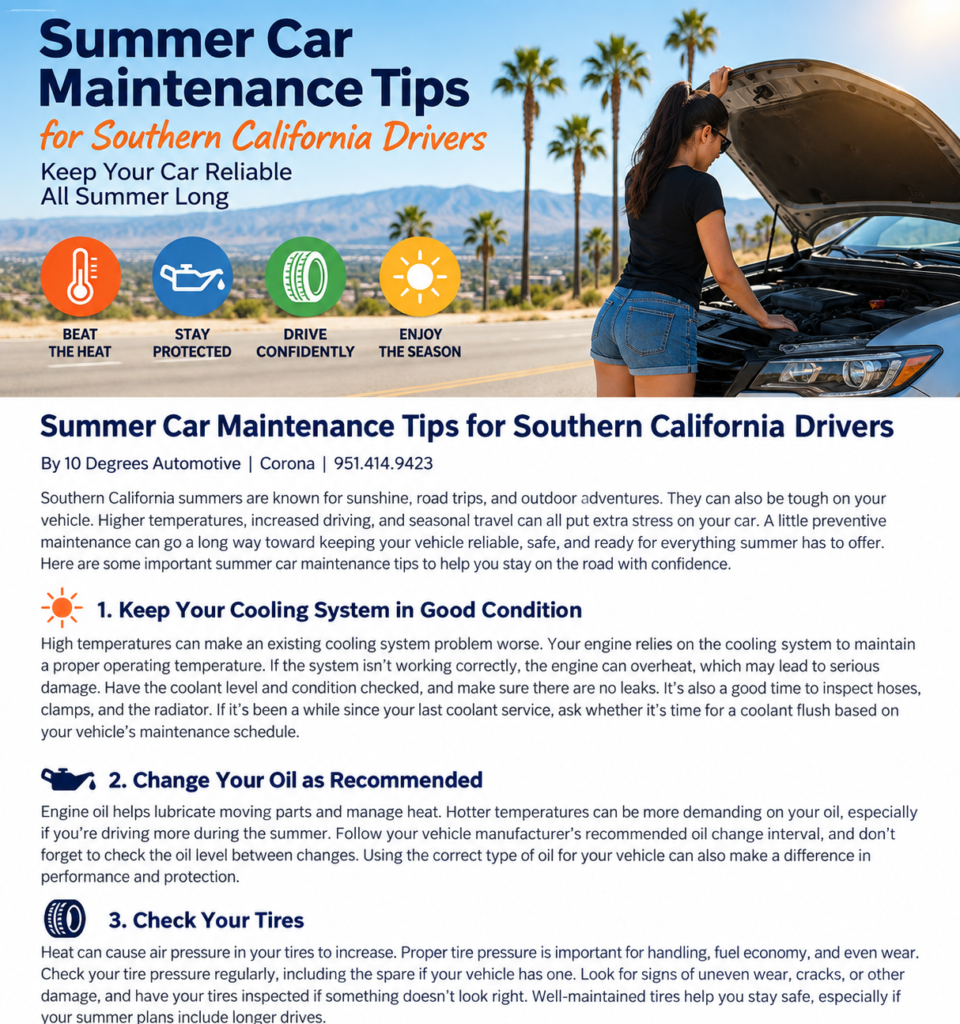
Southern California summers can mean intense heat, long freeway drives, weekend road trips, and plenty of time behind the wheel. Those conditions can also put additional demands on your vehicle, making preventive maintenance especially important before temperatures climb. 10 Degrees Automotive in Corona can help drivers prepare their cars, trucks, and SUVs for summer driving with professional inspections, maintenance, and repairs. If you’re getting your vehicle ready for the heat or planning a summer road trip, call 951.414.9423 to schedule service.
🌡️ 1. Pay Attention to Your Cooling System
Your engine produces a tremendous amount of heat even under normal operating conditions. During hot summer weather, a cooling-system problem can become particularly troublesome.
The engine cooling system is designed to maintain an appropriate operating temperature by circulating coolant through the engine and radiator.
Low coolant, leaks, damaged hoses, radiator problems, thermostat issues, cooling-fan problems, and other faults can potentially contribute to overheating.
Have the coolant level and condition checked as appropriate for your vehicle, and inspect the system for visible signs of leakage.
Cooling-system maintenance should follow the manufacturer’s recommendations for your specific vehicle rather than relying on a universal schedule.
🚨 2. Never Ignore an Overheating Engine
If the temperature gauge moves unusually high or a temperature warning appears, take the situation seriously.
Continuing to drive an overheating vehicle can potentially cause extensive engine damage.
If you see steam coming from under the hood, don’t immediately open the radiator cap or cooling system. Hot coolant can be under pressure and may cause severe burns.
Get to a safe location and shut the vehicle down when appropriate.
An overheating problem needs diagnosis because simply adding coolant may not correct the underlying cause.
The vehicle could have a leak, cooling-fan problem, thermostat issue, water-pump problem, radiator restriction, or another fault requiring repair.
🛢️ 3. Keep Up With Oil Changes
Engine oil plays a critical role in lubricating internal components and helping manage operating conditions inside the engine.
Summer is a good time to check whether you’re approaching your next oil change.
Follow the manufacturer’s recommended oil specification and maintenance interval for your vehicle.
Don’t automatically assume every vehicle needs an oil change at the same mileage. Modern vehicles vary considerably in their requirements.
If your dashboard includes an oil-life monitoring system, pay attention to it while also following the recommendations in your owner’s manual.
Regular oil service is one of the fundamental parts of maintaining your engine throughout the year.
🔍 4. Check the Engine Oil Level
Oil changes aren’t the only time to think about engine oil.
It’s also smart to periodically check the oil level, particularly before a long trip.
Some engines consume a certain amount of oil between services, while leaks can cause the level to decrease unexpectedly.
Running an engine with insufficient oil can result in serious problems.
Check your owner’s manual for the proper procedure because it can vary by vehicle.
If you discover that the oil level repeatedly drops between services, don’t simply continue topping it off indefinitely.
Have the vehicle inspected to determine whether there is an oil leak or excessive oil consumption that needs attention.
🔋 5. Have Your Battery Checked
Drivers often associate battery trouble with cold weather, but summer heat can also be demanding on automotive batteries.
High temperatures can accelerate battery deterioration.
If your battery is several years old, the engine has begun cranking slowly, or you’ve recently needed a jump-start, consider having the battery tested.
Look for obvious corrosion around the battery terminals and pay attention to any physical damage to the battery case.
A battery that’s becoming weak may still start the vehicle today but fail when you least expect it.
Testing before a summer trip can help identify a marginal battery before you’re stranded away from home.
⚡ 6. Don’t Forget the Alternator and Charging System
A healthy battery still depends on a properly operating charging system.
Once the engine is running, the alternator supplies electrical power and helps maintain battery charge.
If the charging system develops a problem, the battery can eventually become discharged.
Watch for warning signs such as a charging-system light, dim or flickering lights, unusual electrical behavior, or repeated dead-battery situations.
Because battery and alternator symptoms can overlap, proper testing is more reliable than guessing which component has failed.
❄️ 7. Make Sure Your Air Conditioning Is Ready
Few automotive problems become more obvious during a Southern California summer than weak air conditioning.
If the vents aren’t blowing as cold as they used to, airflow is weak, cooling performance changes while idling, or the system makes unusual noises, have it inspected.
Automotive air conditioning systems can experience problems involving refrigerant levels, leaks, compressors, condensers, fans, electrical components, controls, and other parts.
Simply adding refrigerant isn’t always the correct solution.
If refrigerant is low, there may be a leak that needs to be located.
A properly diagnosed car AC problem can help you understand what actually needs repair.
🛞 8. Check Tire Pressure Regularly
Tire pressure changes with temperature, making tire maintenance particularly important when seasonal temperatures rise.
Check pressure when the tires are cold and use the vehicle manufacturer’s recommended pressure.
That specification is typically found on the tire-information placard inside the driver’s door area or in the owner’s manual.
Don’t automatically inflate tires to the maximum pressure printed on the tire sidewall.
The sidewall figure isn’t necessarily the correct operating pressure for your specific vehicle.
Correct tire pressure contributes to proper handling, tire wear, and fuel efficiency.
🔎 9. Inspect Your Tire Tread and Condition
Pressure is only part of tire maintenance.
Look at the tread and overall condition of each tire.
Check for uneven wear, cuts, cracking, bulges, embedded objects, or other visible damage.
Uneven wear can sometimes indicate alignment, suspension, inflation, or other problems.
If your tires are approaching the end of their usable tread life, don’t wait until a long summer road trip to address them.
Although Southern California summers may be dry, unexpected rain can still occur, and adequate tread is important when roads become wet.
🔄 10. Rotate Your Tires When Recommended
Regular tire rotation can help promote more even tread wear.
The appropriate rotation interval and pattern depend on your vehicle and tire setup.
Some vehicles use staggered tire sizes or directional tires that may limit how the tires can be rotated.
Follow the applicable maintenance recommendations rather than assuming every vehicle uses the same rotation pattern.
While the tires are being serviced, it’s also a convenient opportunity to inspect their condition and look for developing wear patterns.
🛑 11. Have Your Brakes Inspected
Summer road trips often mean freeway traffic, mountain drives, stop-and-go congestion, and additional miles.
Your braking system needs to be ready.
Possible brake warning signs include squealing, grinding, vibration, pulling, increased stopping distance, a soft or unusual brake pedal, or dashboard warning lights.
Brake pads naturally wear over time, but other components can also require attention.
Rotors, calipers, brake fluid, hoses, and other parts all contribute to braking performance.
If something about the brakes feels or sounds different, don’t postpone an inspection simply because the vehicle still stops.
💧 12. Check Important Vehicle Fluids
Your vehicle may use several different fluids depending on its design.
These can include engine coolant, brake fluid, transmission fluid, power steering fluid, windshield washer fluid, and differential or transfer-case fluids.
Not every fluid is checked or serviced in the same way.
Some modern transmissions, for example, have specific procedures for checking fluid condition and level.
Follow manufacturer recommendations and have fluids inspected or serviced according to the vehicle’s requirements.
If you notice fluid underneath your parked vehicle, don’t assume it’s harmless.
Some condensation from the air conditioning can be normal, but colored, oily, or unusual fluid may indicate a leak.
🚿 13. Keep Windshield Washer Fluid Filled
Summer doesn’t eliminate the need for a clean windshield.
Dust, insects, road grime, and other debris can quickly reduce visibility.
Make sure the windshield washer reservoir has sufficient fluid and that the spray nozzles operate correctly.
This is an inexpensive maintenance item that’s easy to overlook until you need it.
Good visibility matters during daytime driving, but it can be especially important when dirt or residue on the windshield creates glare from direct sunlight or oncoming headlights.
🌧️ 14. Inspect Your Windshield Wipers
Southern California drivers can go long periods without using their windshield wipers, which makes it easy to forget about them.
Heat and sun exposure can deteriorate rubber wiper blades over time.
When rain finally arrives, worn blades may streak, chatter, or fail to clear the windshield effectively.
Inspect your windshield wiper blades periodically and replace them if they’re damaged or no longer performing properly.
Summer preparation isn’t only about hot, dry weather. It’s about making sure the vehicle is prepared for changing driving conditions.
🌬️ 15. Check the Cabin Air Filter
If airflow from your vents seems weaker than expected, a dirty cabin air filter may be one possible contributor.
The cabin air filter helps filter air entering the passenger compartment through the climate-control system.
Over time, it can collect dust, pollen, leaves, and other debris.
Replacement intervals vary by vehicle and driving conditions.
Drivers who frequently travel in dusty areas may need inspection more often.
A clean filter is one part of maintaining effective HVAC airflow, although weak air conditioning can have many other causes that require diagnosis.
🫁 16. Don’t Forget the Engine Air Filter
Your engine also needs clean airflow.
The engine air filter helps prevent dirt and debris from entering the engine’s intake system.
A heavily restricted filter can affect performance.
Instead of replacing it according to a random mileage rule, inspect and replace it based on the manufacturer’s maintenance guidance and actual condition.
Dusty driving conditions can affect how quickly a filter becomes dirty.
Checking it during routine summer maintenance is simple and can help ensure that an overlooked maintenance item doesn’t remain neglected.
🧰 17. Inspect Belts and Hoses
Rubber components under the hood operate in a challenging environment that includes heat and repeated temperature cycles.
Hoses are particularly important to the cooling system, while drive belts may operate accessories and other components depending on the vehicle.
Look for cracks, deterioration, leaks, fraying, glazing, swelling, or other visible damage.
Not every belt or hose problem can be identified visually, but inspection is still worthwhile.
A failed cooling-system hose on a hot summer afternoon can quickly turn an ordinary drive into an overheating situation.
🚘 18. Prepare Before a Summer Road Trip
If you’re planning a long drive, don’t wait until the night before departure to think about maintenance.
Give yourself enough time to have the vehicle inspected and address any problems that are discovered.
A pre-trip vehicle inspection might include checking tires, brakes, fluids, battery condition, cooling-system operation, belts, hoses, lights, wipers, and air conditioning.
Also confirm that you’re up to date on scheduled maintenance.
Preparing early is important because an inspection could uncover something that requires parts or additional repair time.
It’s better to discover a worn component in the shop than hundreds of miles from home.
🧳 19. Carry Basic Roadside Supplies
Even a well-maintained vehicle can experience unexpected problems.
Consider carrying practical roadside items such as drinking water, a flashlight, phone charging equipment, basic first-aid supplies, and appropriate emergency equipment.
Make sure you know whether your vehicle has a spare tire, tire repair kit, or another manufacturer-provided solution.
If it has a spare, check its condition and pressure periodically.
It’s surprisingly common for drivers to discover a flat or unusable spare only after they need it.
Roadside preparation becomes particularly important when traveling through remote or extremely hot areas.
⛽ 20. Pay Attention to Changes in Fuel Economy
A noticeable decline in fuel economy can have many possible explanations.
Tire pressure, driving style, heavy air-conditioning use, traffic conditions, maintenance issues, and mechanical problems can all affect fuel consumption.
One unusual tank isn’t necessarily a reason for concern.
However, if your vehicle consistently begins using significantly more fuel without an obvious change in driving conditions, it may be worth investigating.
Changes in vehicle performance or fuel economy can sometimes provide an early clue that maintenance or repair is needed.
⚠️ 21. Don’t Ignore Dashboard Warning Lights
Summer is not the time to begin a long road trip with unexplained warning lights illuminated.
A check engine light, charging-system warning, temperature warning, oil-pressure warning, brake warning, or tire-pressure warning can indicate very different problems.
Some warnings require more immediate action than others.
Consult your owner’s manual and have significant or persistent warning lights properly diagnosed.
Avoid assuming that a warning light can safely be ignored simply because the vehicle appears to drive normally.
The warning may be the first indication of a developing problem.
🅿️ 22. Heat Can Be Hard on a Parked Vehicle Too
A vehicle doesn’t need to be moving to experience extreme temperatures.
The passenger compartment can become dangerously hot when a car is parked in direct sunlight.
Never leave children or pets unattended in a parked vehicle.
Heat and sun can also affect interior surfaces and items stored inside the car.
Whenever practical, parking in shade or using appropriate sun protection can help reduce direct solar exposure to the interior.
Summer vehicle care includes protecting the car while driving and being aware of the conditions created while it’s parked.
📅 23. Follow Your Vehicle’s Maintenance Schedule
One of the most effective summer maintenance strategies is also one of the simplest: know what your vehicle is due for.
Your owner’s manual contains maintenance information specific to your model.
Depending on mileage, age, operating conditions, and vehicle design, scheduled service can include oil changes, filters, fluid services, spark plugs, inspections, and other maintenance items.
Avoid relying entirely on generic maintenance schedules found online.
Different vehicles can have significantly different requirements.
Keeping records of completed services can also make it easier to know what needs attention next.
🔧 24. Fix Small Problems Before Summer Heat Makes Them Bigger
If your vehicle already has a small coolant leak, weak battery, worn tire, marginal air-conditioning system, or another developing problem, summer driving isn’t likely to make the inconvenience more enjoyable.
Pay attention to changes in how your vehicle starts, sounds, smells, handles, stops, and operates.
Unusual noises, leaks, vibrations, warning lights, or temperature changes deserve investigation.
Preventive auto maintenance doesn’t mean replacing components unnecessarily. It means identifying legitimate maintenance needs and developing problems before they become larger or leave you stranded.
☀️ Get Your Vehicle Ready for Southern California Summer Driving
Summer driving should be about getting where you want to go—not worrying whether your vehicle will survive the heat. Staying on top of cooling-system maintenance, oil changes, battery testing, air conditioning, tire care, brakes, fluids, belts, hoses, filters, and scheduled maintenance can help prepare your car for hot-weather driving and summer road trips. If you’d like your vehicle inspected or serviced before temperatures climb or before your next trip, contact 10 Degrees Automotive in Corona at 951.414.9423 to schedule professional automotive maintenance and repair.

