• 🚗 What Causes a Car to Stall While Driving? Common Causes and Solutions

    By 10 Degrees Automotive | Corona | 951.414.9423

    What Causes a Car to Stall While Driving? Common Causes and Solutions

    A car that suddenly stalls while driving can be frightening, inconvenient, and potentially dangerous. Whether your engine shuts off at a stoplight, loses power on the freeway, or stalls while accelerating, understanding the possible causes can help you avoid costly repairs and dangerous situations. At 10 Degrees Automotive in Corona, our experienced technicians specialize in identifying and repairing engine stalling problems, fuel system issues, and electrical malfunctions. If your vehicle has been unexpectedly shutting off, call 951.414.9423 to schedule a professional inspection and get your car running reliably again.

    🔧 What Does It Mean When Your Car Stalls?

    A car stalls when the engine unexpectedly stops running. This can happen while idling, accelerating, slowing down, or traveling at highway speeds.

    Modern vehicles depend on a precise combination of fuel, air, ignition, electrical power, and computer-controlled systems to operate correctly. When one of these systems fails, the engine may lose the ability to continue running.

    Common warning signs include:

    • Sudden loss of engine power while driving
    • Engine sputtering or hesitation before shutting off
    • Rough idling or unusual vibrations
    • Difficulty restarting the vehicle
    • Check engine light illuminating
    • Intermittent stalling at stoplights or intersections
    • Engine shutting off when accelerating or braking

    Although some stalling problems are relatively minor, others indicate serious mechanical or electrical issues that require immediate attention.

    ⛽ 1. Fuel System Problems

    One of the most common reasons a car stalls while driving is an interruption in the fuel supply.

    Your engine requires a consistent amount of fuel at the correct pressure to maintain combustion. If fuel delivery becomes restricted or stops entirely, the engine may stall.

    Failing Fuel Pump

    The fuel pump transfers gasoline from the fuel tank to the engine. When it begins failing, the engine may not receive sufficient fuel pressure.

    Symptoms of a failing fuel pump include:

    • Engine hesitation during acceleration
    • Difficulty starting the vehicle
    • Sudden engine shutdown
    • Loss of power under heavy loads
    • Engine sputtering at higher speeds

    A failing fuel pump may work intermittently, making the problem difficult to diagnose without professional testing.

    Clogged Fuel Filter

    A clogged fuel filter can restrict fuel flow, particularly when the engine requires additional fuel during acceleration.

    Not every vehicle has an externally replaceable fuel filter, but fuel delivery restrictions can occur in many different fuel system designs.

    Dirty or Malfunctioning Fuel Injectors

    Fuel injectors deliver precise amounts of gasoline into the engine. Dirty, clogged, or malfunctioning injectors can cause uneven fuel delivery, misfires, and rough engine operation.

    In severe cases, fuel delivery problems can contribute to stalling.

    ⚡ 2. Ignition System Failures

    Your vehicle’s ignition system generates the spark necessary to ignite the air-fuel mixture inside the engine.

    If ignition components malfunction, combustion may become inconsistent or stop altogether.

    Common ignition-related problems include:

    • Worn spark plugs
    • Failing ignition coils
    • Damaged ignition wiring
    • Faulty ignition control components
    • Intermittent electrical connections

    A failing ignition coil may cause noticeable hesitation, rough acceleration, or engine misfires before the vehicle stalls.

    Some ignition-related failures become more noticeable as engine temperatures rise, causing the vehicle to stall after driving for an extended period.

    Professional engine diagnostics can help determine whether the problem originates in the ignition system or another component.

    🔋 3. Alternator and Battery Problems

    Your vehicle relies on a properly functioning charging system to power essential electrical components while the engine runs.

    The alternator supplies electricity to the vehicle and recharges the battery. If the alternator fails, the vehicle may eventually lose enough electrical power to shut down.

    Signs of charging system problems include:

    • Battery warning light appearing on the dashboard
    • Headlights dimming unexpectedly
    • Electrical accessories malfunctioning
    • Difficulty restarting the engine
    • Engine shutting off while driving

    A weak battery alone does not always cause a running engine to stall. However, a failed alternator, poor battery connections, or damaged electrical wiring can interrupt the power required by modern engine management systems.

    A professional battery and alternator inspection can identify charging problems before they leave you stranded.

    🌬️ 4. Dirty Throttle Body or Air Intake Problems

    Your engine needs the correct amount of air to maintain smooth operation.

    A dirty or malfunctioning throttle body can interfere with airflow, particularly when the vehicle slows down or returns to idle.

    Carbon buildup around the throttle plate may prevent proper airflow control.

    Common symptoms include:

    • Engine stalling at stoplights
    • Rough or unstable idle
    • Hesitation when pressing the accelerator
    • Engine speed fluctuating unexpectedly
    • Stalling when shifting into gear

    Some vehicles may also experience stalling because of vacuum leaks, intake air restrictions, or electronic throttle control problems.

    A thorough inspection can determine whether cleaning, adjustment, or component replacement is necessary.

    🧠 5. Faulty Engine Sensors

    Modern vehicles use multiple electronic sensors to monitor engine performance and communicate with the engine control module (ECM).

    When a critical sensor provides inaccurate information or stops functioning, the engine may stall.

    Crankshaft Position Sensor

    The crankshaft position sensor monitors crankshaft speed and position, helping the engine computer manage ignition and fuel injection timing.

    When this sensor fails, the engine may suddenly shut off and refuse to restart until the sensor or surrounding components cool down.

    Camshaft Position Sensor

    The camshaft position sensor helps the engine computer coordinate valve timing information and fuel injection or ignition functions.

    A malfunction may cause hard starting, rough operation, reduced performance, or stalling, depending on the vehicle.

    Mass Airflow Sensor

    The mass airflow (MAF) sensor measures the amount of air entering the engine.

    Incorrect airflow readings can cause improper fuel delivery, resulting in hesitation, rough idling, and possible stalling.

    Because several sensor failures can produce similar symptoms, computerized engine diagnostics are essential for identifying the actual cause rather than replacing parts unnecessarily.

    🚦 6. Why Does My Car Stall When I Stop?

    If your vehicle runs normally at highway speeds but stalls when approaching a stoplight, the problem may involve idle control, airflow, or transmission operation.

    Potential causes include:

    • Dirty throttle body
    • Electronic throttle control malfunction
    • Vacuum leaks
    • Incorrect air-fuel mixture
    • Faulty engine sensors
    • Torque converter clutch problems

    In automatic transmission vehicles, a torque converter clutch that fails to disengage can cause the engine to stall as the vehicle comes to a stop.

    This can feel similar to stopping a manual transmission vehicle without pressing the clutch pedal.

    Proper diagnosis helps distinguish between engine performance problems and transmission-related issues.

    🚘 7. Why Does My Car Stall While Accelerating?

    A vehicle that stalls during acceleration may be experiencing problems that become more noticeable when engine demand increases.

    Possible causes include:

    • Weak fuel pump
    • Restricted fuel delivery
    • Ignition system malfunction
    • Faulty airflow sensor
    • Electrical connection problems
    • Engine management system failures

    Acceleration requires additional fuel and precise ignition timing. If the engine cannot meet these demands, it may hesitate, lose power, or shut off.

    Engine hesitation and stalling should never be ignored, especially when merging onto freeways or navigating busy intersections.

    🌡️ 8. Engine Overheating and Mechanical Problems

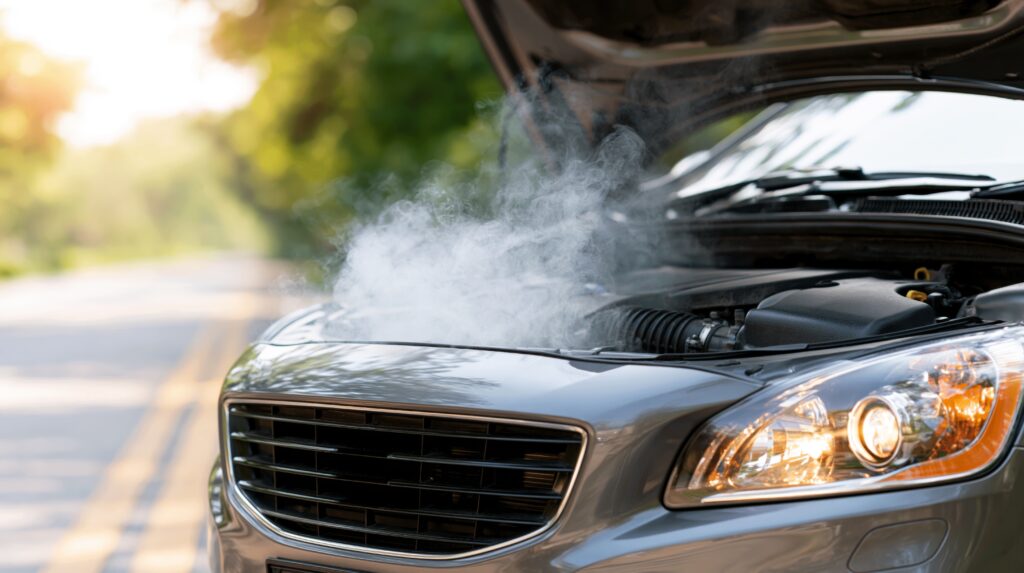
    An overheating engine can experience serious performance problems, and some vehicles may reduce power or shut down to protect critical components.

    Potential causes include:

    • Low coolant levels
    • Malfunctioning thermostat
    • Cooling fan failure
    • Water pump problems
    • Radiator restrictions
    • Severe internal engine damage

    If your temperature gauge rises into the red zone or an overheating warning appears, safely pull over and shut off the engine.

    Continuing to drive an overheating vehicle can cause significant engine damage, including warped cylinder heads and head gasket failure.

    Never remove the radiator cap while the engine is hot.

    ⚠️ Is It Dangerous If Your Car Stalls While Driving?

    Yes. Unexpected engine stalling can create serious safety hazards, particularly at freeway speeds or in heavy traffic.

    When the engine shuts off, the vehicle may lose power steering assistance, making the steering wheel significantly harder to turn. Power brake assistance may also become limited, requiring additional pressure on the brake pedal.

    The vehicle can generally still be steered and braked, but controlling it may require substantially more effort.

    If your car stalls while driving:

    1. Stay calm and maintain control of the steering wheel.
    2. Activate your hazard lights to alert surrounding drivers.
    3. Steer toward a safe location away from moving traffic.
    4. Apply steady brake pressure and avoid repeatedly pumping the brakes.
    5. Shift into Park once stopped and secure the vehicle.
    6. Request roadside assistance if the vehicle cannot be safely driven.

    If the vehicle stalls repeatedly, avoid attempting to drive it to a repair facility. Having it towed is generally the safer option.

    🔍 How Do Mechanics Diagnose a Stalling Engine?

    Because multiple mechanical and electrical problems can cause similar symptoms, accurately identifying the cause requires a systematic diagnostic approach.

    A professional automotive diagnostic inspection may include:

    • OBD-II diagnostic scanning: Checking stored and pending trouble codes and reviewing relevant engine data.
    • Fuel pressure testing: Evaluating fuel delivery and identifying pressure irregularities.
    • Ignition system inspection: Testing spark plugs, ignition coils, and related electrical components.
    • Charging system testing: Measuring alternator output, battery condition, and electrical connections.
    • Air intake inspection: Checking throttle operation, intake components, and possible vacuum leaks.
    • Sensor evaluation: Examining live data and testing sensors associated with engine timing and fuel management.

    Intermittent problems may require additional testing or controlled road testing to reproduce the conditions under which the engine stalls.

    An accurate diagnosis can prevent unnecessary repairs and help restore dependable vehicle operation.

    🛠️ How Can You Prevent Your Car From Stalling?

    Not every stalling problem is preventable, but regular maintenance can reduce the risk of unexpected breakdowns.

    Follow Your Vehicle’s Maintenance Schedule

    Routine maintenance helps keep critical engine components operating correctly.

    Follow manufacturer recommendations for spark plug replacement, air filter service, and other scheduled maintenance.

    Address Check Engine Lights Promptly

    A check engine light may indicate an issue with ignition, fuel delivery, emissions, or engine management.

    Having the vehicle inspected early can help identify developing problems before they lead to a breakdown.

    Maintain Your Battery and Charging System

    Periodic battery and alternator testing can reveal electrical problems that might otherwise cause unexpected starting or running issues.

    Pay Attention to Changes in Performance

    Rough idling, hesitation, unusual vibrations, and difficulty starting are signs that your vehicle may need attention.

    Addressing these symptoms early can help reduce the risk of more extensive damage.

    Schedule Regular Vehicle Inspections

    Professional inspections can identify worn components, damaged wiring, fluid leaks, and other conditions that may affect engine reliability.

    Preventive maintenance is often more convenient and affordable than dealing with an unexpected roadside breakdown.

    💰 How Much Does It Cost to Fix a Car That Stalls?

    The cost of car stalling repairs depends on the underlying problem, vehicle make and model, labor requirements, and replacement parts.

    Some issues, such as a dirty throttle body or loose electrical connection, may be relatively straightforward to correct.

    Other problems, including fuel pump replacement, extensive wiring repairs, or transmission-related failures, can require more involved service.

    Because stalling can have many causes, replacing parts without confirming the problem may result in unnecessary expenses.

    A professional diagnosis provides a clearer understanding of the repairs needed and helps you make an informed decision about your vehicle.

    📍 Professional Car Stalling Diagnostics in Corona

    If your vehicle is stalling unexpectedly, it is important to have the problem evaluated before it becomes a more serious safety concern.

    Drivers in Corona and surrounding communities can benefit from professional diagnostic services designed to identify the source of engine performance problems.

    Whether your car stalls at idle, shuts off during acceleration, or loses power after warming up, identifying the underlying cause is the first step toward restoring reliable performance.

    From fuel system diagnostics and ignition system testing to electrical troubleshooting and engine performance repairs, a comprehensive inspection can help determine the appropriate solution.

    🚗 Schedule Your Engine Diagnostic Inspection Today!

    Don’t let an unexpected engine stall put your safety or your vehicle’s reliability at risk. Whether you’re experiencing intermittent engine stalling, rough idling, sudden loss of power, or difficulty restarting your car, professional diagnostics can help identify the cause and prevent further complications. Trust 10 Degrees Automotive in Corona for dependable automotive service and expert troubleshooting. Call 951.414.9423 today to schedule your engine diagnostic inspection and get back on the road with confidence!

  • 🔧 Why Regular Auto Maintenance Saves You Money (and Your Car)

    10 Degree Automotive – Your Trusted Auto Repair Experts | 951-404-1103

    Why Regular Auto Maintenance Saves You Money (and Your Car)

    When your car is running smoothly, it’s easy to forget about maintenance — until a dashboard light comes on, a strange noise starts, or something breaks unexpectedly. But routine auto care is one of the smartest investments you can make in your vehicle. At 10 Degree Automotive, we help drivers stay safe on the road, avoid costly repairs, and extend the life of their vehicles through reliable, professional service. 🚗✨

    If you need dependable auto repair or maintenance, call 951-404-1103 today.


    🔍 The Real Cost of Skipping Maintenance

    Skipping oil changes, ignoring fluid levels, or putting off inspections might seem harmless… until it leads to:

    • Engine overheating
    • Premature brake wear
    • Transmission failure
    • Tire blowouts
    • Poor fuel efficiency

    These issues don’t just cost money — they can leave you stranded or unsafe on the road. Routine service lets you catch problems early before they snowball into major repairs. 🛠️💸


    🛢️ Essential Maintenance Services Every Driver Needs

    1. Oil & Filter Changes

    Your engine depends on clean oil to stay cool, lubricated, and efficient. Regular oil changes prevent wear and protect your engine.

    2. Brake Inspections & Service

    Soft brakes, squeaking, or vibration are signs you need service. Maintaining your brake pads and rotors ensures safe stopping power every time. 🛑

    3. Fluid Checks & Flushes

    Transmission, coolant, brake fluid, and power steering fluid keep your vehicle running smoothly. Keeping them fresh prevents overheating and major system failures.

    4. Tire Rotation & Alignment

    Proper alignment improves fuel efficiency and extends tire life. If your car pulls to one side, it’s time for an alignment check.

    5. Battery Testing

    A weak battery can leave you stranded without warning. Professional testing helps avoid unexpected breakdowns. ⚡


    🚗 Why Choose 10 Degree Automotive?

    When you trust 10 Degree Automotive, you’re choosing:

    ✔️ Certified, experienced technicians
    ✔️ Honest diagnostics & fair pricing
    ✔️ Quality parts and long-lasting repairs
    ✔️ Fast turnaround times
    ✔️ Friendly, customer-focused service

    We treat every vehicle like it’s our own — because your safety matters. For questions or scheduling, call 951-404-1103.


    🏁 The Benefits of Staying on Top of Car Care

    Routine maintenance helps you:

    • Improve fuel efficiency
    • Boost overall performance
    • Prevent major breakdowns
    • Extend vehicle lifespan
    • Maintain resale value
    • Drive with confidence

    A well-maintained car is safer, smoother, and more reliable. 😎


    📞 Ready to Take Better Care of Your Car?

    Whether you need an oil change, diagnostics, brake repair, or a full inspection, 10 Degree Automotive is here to help.

    📍 10 Degree Automotive –Your Local Auto Repair Experts
    📞 951-404-1103

    Call today to schedule your next service!

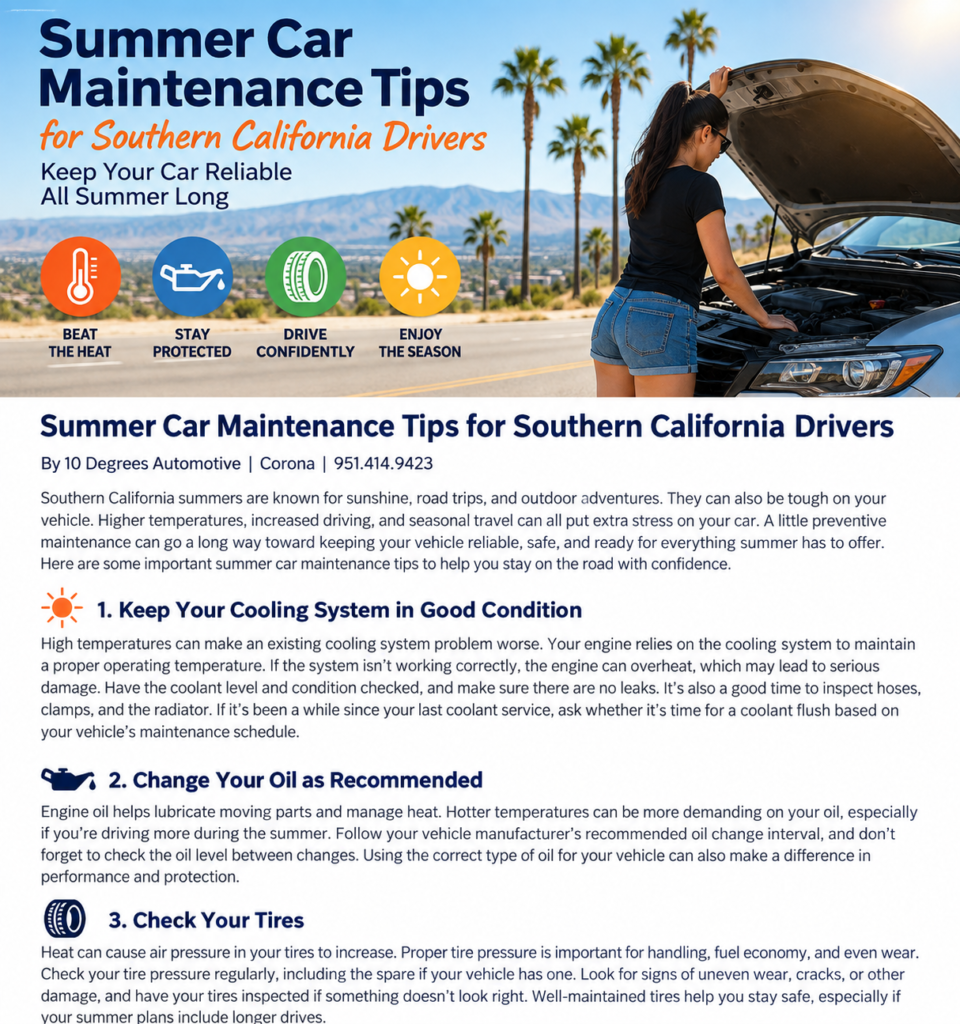
  • ☀️ Summer Car Maintenance Tips for Southern California Drivers

    By 10 Degrees Automotive | Corona | 951.414.9423

    Summer Car Maintenance Tips for Southern California Drivers

    Southern California summers can mean intense heat, long freeway drives, weekend road trips, and plenty of time behind the wheel. Those conditions can also put additional demands on your vehicle, making preventive maintenance especially important before temperatures climb. 10 Degrees Automotive in Corona can help drivers prepare their cars, trucks, and SUVs for summer driving with professional inspections, maintenance, and repairs. If you’re getting your vehicle ready for the heat or planning a summer road trip, call 951.414.9423 to schedule service.

    🌡️ 1. Pay Attention to Your Cooling System

    Your engine produces a tremendous amount of heat even under normal operating conditions. During hot summer weather, a cooling-system problem can become particularly troublesome.

    The engine cooling system is designed to maintain an appropriate operating temperature by circulating coolant through the engine and radiator.

    Low coolant, leaks, damaged hoses, radiator problems, thermostat issues, cooling-fan problems, and other faults can potentially contribute to overheating.

    Have the coolant level and condition checked as appropriate for your vehicle, and inspect the system for visible signs of leakage.

    Cooling-system maintenance should follow the manufacturer’s recommendations for your specific vehicle rather than relying on a universal schedule.

    🚨 2. Never Ignore an Overheating Engine

    If the temperature gauge moves unusually high or a temperature warning appears, take the situation seriously.

    Continuing to drive an overheating vehicle can potentially cause extensive engine damage.

    If you see steam coming from under the hood, don’t immediately open the radiator cap or cooling system. Hot coolant can be under pressure and may cause severe burns.

    Get to a safe location and shut the vehicle down when appropriate.

    An overheating problem needs diagnosis because simply adding coolant may not correct the underlying cause.

    The vehicle could have a leak, cooling-fan problem, thermostat issue, water-pump problem, radiator restriction, or another fault requiring repair.

    🛢️ 3. Keep Up With Oil Changes

    Engine oil plays a critical role in lubricating internal components and helping manage operating conditions inside the engine.

    Summer is a good time to check whether you’re approaching your next oil change.

    Follow the manufacturer’s recommended oil specification and maintenance interval for your vehicle.

    Don’t automatically assume every vehicle needs an oil change at the same mileage. Modern vehicles vary considerably in their requirements.

    If your dashboard includes an oil-life monitoring system, pay attention to it while also following the recommendations in your owner’s manual.

    Regular oil service is one of the fundamental parts of maintaining your engine throughout the year.

    🔍 4. Check the Engine Oil Level

    Oil changes aren’t the only time to think about engine oil.

    It’s also smart to periodically check the oil level, particularly before a long trip.

    Some engines consume a certain amount of oil between services, while leaks can cause the level to decrease unexpectedly.

    Running an engine with insufficient oil can result in serious problems.

    Check your owner’s manual for the proper procedure because it can vary by vehicle.

    If you discover that the oil level repeatedly drops between services, don’t simply continue topping it off indefinitely.

    Have the vehicle inspected to determine whether there is an oil leak or excessive oil consumption that needs attention.

    🔋 5. Have Your Battery Checked

    Drivers often associate battery trouble with cold weather, but summer heat can also be demanding on automotive batteries.

    High temperatures can accelerate battery deterioration.

    If your battery is several years old, the engine has begun cranking slowly, or you’ve recently needed a jump-start, consider having the battery tested.

    Look for obvious corrosion around the battery terminals and pay attention to any physical damage to the battery case.

    A battery that’s becoming weak may still start the vehicle today but fail when you least expect it.

    Testing before a summer trip can help identify a marginal battery before you’re stranded away from home.

    ⚡ 6. Don’t Forget the Alternator and Charging System

    A healthy battery still depends on a properly operating charging system.

    Once the engine is running, the alternator supplies electrical power and helps maintain battery charge.

    If the charging system develops a problem, the battery can eventually become discharged.

    Watch for warning signs such as a charging-system light, dim or flickering lights, unusual electrical behavior, or repeated dead-battery situations.

    Because battery and alternator symptoms can overlap, proper testing is more reliable than guessing which component has failed.

    ❄️ 7. Make Sure Your Air Conditioning Is Ready

    Few automotive problems become more obvious during a Southern California summer than weak air conditioning.

    If the vents aren’t blowing as cold as they used to, airflow is weak, cooling performance changes while idling, or the system makes unusual noises, have it inspected.

    Automotive air conditioning systems can experience problems involving refrigerant levels, leaks, compressors, condensers, fans, electrical components, controls, and other parts.

    Simply adding refrigerant isn’t always the correct solution.

    If refrigerant is low, there may be a leak that needs to be located.

    A properly diagnosed car AC problem can help you understand what actually needs repair.

    🛞 8. Check Tire Pressure Regularly

    Tire pressure changes with temperature, making tire maintenance particularly important when seasonal temperatures rise.

    Check pressure when the tires are cold and use the vehicle manufacturer’s recommended pressure.

    That specification is typically found on the tire-information placard inside the driver’s door area or in the owner’s manual.

    Don’t automatically inflate tires to the maximum pressure printed on the tire sidewall.

    The sidewall figure isn’t necessarily the correct operating pressure for your specific vehicle.

    Correct tire pressure contributes to proper handling, tire wear, and fuel efficiency.

    🔎 9. Inspect Your Tire Tread and Condition

    Pressure is only part of tire maintenance.

    Look at the tread and overall condition of each tire.

    Check for uneven wear, cuts, cracking, bulges, embedded objects, or other visible damage.

    Uneven wear can sometimes indicate alignment, suspension, inflation, or other problems.

    If your tires are approaching the end of their usable tread life, don’t wait until a long summer road trip to address them.

    Although Southern California summers may be dry, unexpected rain can still occur, and adequate tread is important when roads become wet.

    🔄 10. Rotate Your Tires When Recommended

    Regular tire rotation can help promote more even tread wear.

    The appropriate rotation interval and pattern depend on your vehicle and tire setup.

    Some vehicles use staggered tire sizes or directional tires that may limit how the tires can be rotated.

    Follow the applicable maintenance recommendations rather than assuming every vehicle uses the same rotation pattern.

    While the tires are being serviced, it’s also a convenient opportunity to inspect their condition and look for developing wear patterns.

    🛑 11. Have Your Brakes Inspected

    Summer road trips often mean freeway traffic, mountain drives, stop-and-go congestion, and additional miles.

    Your braking system needs to be ready.

    Possible brake warning signs include squealing, grinding, vibration, pulling, increased stopping distance, a soft or unusual brake pedal, or dashboard warning lights.

    Brake pads naturally wear over time, but other components can also require attention.

    Rotors, calipers, brake fluid, hoses, and other parts all contribute to braking performance.

    If something about the brakes feels or sounds different, don’t postpone an inspection simply because the vehicle still stops.

    💧 12. Check Important Vehicle Fluids

    Your vehicle may use several different fluids depending on its design.

    These can include engine coolant, brake fluid, transmission fluid, power steering fluid, windshield washer fluid, and differential or transfer-case fluids.

    Not every fluid is checked or serviced in the same way.

    Some modern transmissions, for example, have specific procedures for checking fluid condition and level.

    Follow manufacturer recommendations and have fluids inspected or serviced according to the vehicle’s requirements.

    If you notice fluid underneath your parked vehicle, don’t assume it’s harmless.

    Some condensation from the air conditioning can be normal, but colored, oily, or unusual fluid may indicate a leak.

    🚿 13. Keep Windshield Washer Fluid Filled

    Summer doesn’t eliminate the need for a clean windshield.

    Dust, insects, road grime, and other debris can quickly reduce visibility.

    Make sure the windshield washer reservoir has sufficient fluid and that the spray nozzles operate correctly.

    This is an inexpensive maintenance item that’s easy to overlook until you need it.

    Good visibility matters during daytime driving, but it can be especially important when dirt or residue on the windshield creates glare from direct sunlight or oncoming headlights.

    🌧️ 14. Inspect Your Windshield Wipers

    Southern California drivers can go long periods without using their windshield wipers, which makes it easy to forget about them.

    Heat and sun exposure can deteriorate rubber wiper blades over time.

    When rain finally arrives, worn blades may streak, chatter, or fail to clear the windshield effectively.

    Inspect your windshield wiper blades periodically and replace them if they’re damaged or no longer performing properly.

    Summer preparation isn’t only about hot, dry weather. It’s about making sure the vehicle is prepared for changing driving conditions.

    🌬️ 15. Check the Cabin Air Filter

    If airflow from your vents seems weaker than expected, a dirty cabin air filter may be one possible contributor.

    The cabin air filter helps filter air entering the passenger compartment through the climate-control system.

    Over time, it can collect dust, pollen, leaves, and other debris.

    Replacement intervals vary by vehicle and driving conditions.

    Drivers who frequently travel in dusty areas may need inspection more often.

    A clean filter is one part of maintaining effective HVAC airflow, although weak air conditioning can have many other causes that require diagnosis.

    🫁 16. Don’t Forget the Engine Air Filter

    Your engine also needs clean airflow.

    The engine air filter helps prevent dirt and debris from entering the engine’s intake system.

    A heavily restricted filter can affect performance.

    Instead of replacing it according to a random mileage rule, inspect and replace it based on the manufacturer’s maintenance guidance and actual condition.

    Dusty driving conditions can affect how quickly a filter becomes dirty.

    Checking it during routine summer maintenance is simple and can help ensure that an overlooked maintenance item doesn’t remain neglected.

    🧰 17. Inspect Belts and Hoses

    Rubber components under the hood operate in a challenging environment that includes heat and repeated temperature cycles.

    Hoses are particularly important to the cooling system, while drive belts may operate accessories and other components depending on the vehicle.

    Look for cracks, deterioration, leaks, fraying, glazing, swelling, or other visible damage.

    Not every belt or hose problem can be identified visually, but inspection is still worthwhile.

    A failed cooling-system hose on a hot summer afternoon can quickly turn an ordinary drive into an overheating situation.

    🚘 18. Prepare Before a Summer Road Trip

    If you’re planning a long drive, don’t wait until the night before departure to think about maintenance.

    Give yourself enough time to have the vehicle inspected and address any problems that are discovered.

    A pre-trip vehicle inspection might include checking tires, brakes, fluids, battery condition, cooling-system operation, belts, hoses, lights, wipers, and air conditioning.

    Also confirm that you’re up to date on scheduled maintenance.

    Preparing early is important because an inspection could uncover something that requires parts or additional repair time.

    It’s better to discover a worn component in the shop than hundreds of miles from home.

    🧳 19. Carry Basic Roadside Supplies

    Even a well-maintained vehicle can experience unexpected problems.

    Consider carrying practical roadside items such as drinking water, a flashlight, phone charging equipment, basic first-aid supplies, and appropriate emergency equipment.

    Make sure you know whether your vehicle has a spare tire, tire repair kit, or another manufacturer-provided solution.

    If it has a spare, check its condition and pressure periodically.

    It’s surprisingly common for drivers to discover a flat or unusable spare only after they need it.

    Roadside preparation becomes particularly important when traveling through remote or extremely hot areas.

    ⛽ 20. Pay Attention to Changes in Fuel Economy

    A noticeable decline in fuel economy can have many possible explanations.

    Tire pressure, driving style, heavy air-conditioning use, traffic conditions, maintenance issues, and mechanical problems can all affect fuel consumption.

    One unusual tank isn’t necessarily a reason for concern.

    However, if your vehicle consistently begins using significantly more fuel without an obvious change in driving conditions, it may be worth investigating.

    Changes in vehicle performance or fuel economy can sometimes provide an early clue that maintenance or repair is needed.

    ⚠️ 21. Don’t Ignore Dashboard Warning Lights

    Summer is not the time to begin a long road trip with unexplained warning lights illuminated.

    A check engine light, charging-system warning, temperature warning, oil-pressure warning, brake warning, or tire-pressure warning can indicate very different problems.

    Some warnings require more immediate action than others.

    Consult your owner’s manual and have significant or persistent warning lights properly diagnosed.

    Avoid assuming that a warning light can safely be ignored simply because the vehicle appears to drive normally.

    The warning may be the first indication of a developing problem.

    🅿️ 22. Heat Can Be Hard on a Parked Vehicle Too

    A vehicle doesn’t need to be moving to experience extreme temperatures.

    The passenger compartment can become dangerously hot when a car is parked in direct sunlight.

    Never leave children or pets unattended in a parked vehicle.

    Heat and sun can also affect interior surfaces and items stored inside the car.

    Whenever practical, parking in shade or using appropriate sun protection can help reduce direct solar exposure to the interior.

    Summer vehicle care includes protecting the car while driving and being aware of the conditions created while it’s parked.

    📅 23. Follow Your Vehicle’s Maintenance Schedule

    One of the most effective summer maintenance strategies is also one of the simplest: know what your vehicle is due for.

    Your owner’s manual contains maintenance information specific to your model.

    Depending on mileage, age, operating conditions, and vehicle design, scheduled service can include oil changes, filters, fluid services, spark plugs, inspections, and other maintenance items.

    Avoid relying entirely on generic maintenance schedules found online.

    Different vehicles can have significantly different requirements.

    Keeping records of completed services can also make it easier to know what needs attention next.

    🔧 24. Fix Small Problems Before Summer Heat Makes Them Bigger

    If your vehicle already has a small coolant leak, weak battery, worn tire, marginal air-conditioning system, or another developing problem, summer driving isn’t likely to make the inconvenience more enjoyable.

    Pay attention to changes in how your vehicle starts, sounds, smells, handles, stops, and operates.

    Unusual noises, leaks, vibrations, warning lights, or temperature changes deserve investigation.

    Preventive auto maintenance doesn’t mean replacing components unnecessarily. It means identifying legitimate maintenance needs and developing problems before they become larger or leave you stranded.

    ☀️ Get Your Vehicle Ready for Southern California Summer Driving

    Summer driving should be about getting where you want to go—not worrying whether your vehicle will survive the heat. Staying on top of cooling-system maintenance, oil changes, battery testing, air conditioning, tire care, brakes, fluids, belts, hoses, filters, and scheduled maintenance can help prepare your car for hot-weather driving and summer road trips. If you’d like your vehicle inspected or serviced before temperatures climb or before your next trip, contact 10 Degrees Automotive in Corona at 951.414.9423 to schedule professional automotive maintenance and repair.

  • 🚗 Why Won’t My Car Start? Battery, Alternator, and Starter Problems

    By 10 Degrees Automotive | Corona | 951.414.9423

    Why Won’t My Car Start? Battery, Alternator, and Starter Problems

    You turn the key or press the start button and expect the engine to come to life—but instead, you hear clicking, slow cranking, or nothing at all. When a vehicle suddenly refuses to start, the battery, alternator, and starter are three common areas to investigate, but they aren’t the only possibilities. At 10 Degrees Automotive in Corona, professional diagnosis can help determine why your vehicle isn’t starting and what actually needs attention. If you’re experiencing starting or electrical problems, call 951.414.9423 to schedule an inspection.

    🔋 Is the Battery Causing Your Car Not to Start?

    A weak or discharged battery is one of the first things many drivers suspect when their vehicle won’t start.

    That’s understandable. Starting an engine requires significant electrical energy, and the battery provides the power needed for the starter to crank the engine.

    If the battery doesn’t have sufficient charge or can no longer provide adequate starting power, you may experience a slow crank, clicking sound, dim lights, or complete no-start condition.

    However, a dead battery doesn’t necessarily mean the battery itself is defective.

    The real question is: Why did the battery lose its charge?

    It may simply be old or weak, but the charging system, electrical connections, or an unwanted electrical draw could also be involved.

    🔑 What Does a Weak Battery Sound Like?

    Pay attention to what happens when you attempt to start the car.

    A weak battery may cause the engine to crank more slowly than usual. Instead of the normal strong starting sound, the engine may turn over sluggishly.

    You might also hear rapid clicking.

    In some cases, dashboard and interior lights illuminate normally until you attempt to start the vehicle, at which point they become noticeably dimmer.

    These symptoms can point toward low battery voltage or insufficient starting power, but testing is still important because poor electrical connections and other problems can create similar behavior.

    💡 Check for Other Battery Warning Signs

    Starting trouble isn’t always the first indication of a battery problem.

    You may have noticed symptoms developing beforehand.

    Possible warning signs include dim headlights, slow engine cranking, repeated jump-starts, electrical accessories behaving inconsistently, corrosion around battery terminals, or a battery that repeatedly loses its charge.

    Battery age is another consideration.

    Automotive batteries have a limited service life, although the actual lifespan varies based on battery design, vehicle use, climate, driving habits, electrical demands, and other factors.

    If the battery has been in service for several years and starting performance has changed, testing it can provide useful information.

    ⚡ Could the Alternator Be the Real Problem?

    A dead battery and a failing alternator can sometimes look very similar from the driver’s perspective.

    That’s because these components work together.

    The battery provides electrical energy to start the engine. Once the engine is running, the alternator supplies electrical power and helps recharge the battery.

    If the alternator isn’t producing adequate output, the vehicle may continue operating temporarily using stored battery energy.

    Eventually, that energy can become depleted.

    The result?

    You may end up with a dead battery even though the battery wasn’t the original cause of the problem.

    ⚠️ Signs of a Possible Alternator Problem

    A charging-system problem can produce several symptoms.

    You might see a battery-shaped or charging-system warning light on the dashboard.

    Headlights could become dim or change brightness. Electrical accessories may behave inconsistently. Dashboard displays might flicker or reset.

    In some situations, the engine may stop running after the available battery charge becomes too low.

    A vehicle that starts after a jump but later experiences another dead battery may also have a charging problem—although other causes are possible.

    These symptoms are reasons to have the charging system professionally tested, not proof by themselves that the alternator needs replacement.

    🚨 What Does the Battery Warning Light Actually Mean?

    A battery-shaped dashboard light is commonly misunderstood.

    Drivers often assume it means, “My battery is bad.”

    More accurately, it generally points to a charging-system problem.

    The alternator is one possible cause, but wiring, electrical connections, control systems, or belt-related problems on applicable vehicles may also be involved.

    If the charging warning appears while you’re driving, don’t assume you can simply replace the battery later and solve the problem.

    The battery may be losing its charge because the vehicle isn’t replenishing it properly.

    Ignoring the warning could eventually result in the vehicle shutting down or failing to restart.

    🔧 Could the Starter Be Why the Engine Won’t Crank?

    The starter has a different job.

    When you turn the key or press the start button, the starter uses electrical energy from the battery to crank the engine.

    If the starter or related starting-system components develop a problem, the engine may not crank correctly even when the battery has adequate power.

    This creates an important diagnostic challenge.

    A weak battery can prevent the starter from working normally, while a faulty starter can make it seem like the battery is weak.

    That’s why simply hearing a click doesn’t provide a complete diagnosis.

    👂 What Does a Bad Starter Sound Like?

    Starter-related symptoms vary.

    You may hear a single click when attempting to start the engine.

    The vehicle may occasionally start normally and then refuse to crank at another time.

    In other situations, the starter may make unusual noises or fail to respond as expected.

    But these symptoms can overlap with battery and electrical connection problems.

    Before replacing a starter, technicians can evaluate the battery condition, electrical connections, starter circuit, and starting-system operation.

    The goal is to identify the actual failure rather than replacing an expensive component based on a guess.

    🔄 Why Does My Car Start With a Jump and Then Die Again?

    This is an important clue, but it still doesn’t provide a guaranteed answer.

    A jump-start supplies additional electrical energy, allowing a vehicle with a discharged battery to start.

    If the engine starts but the battery becomes discharged again, several possibilities exist.

    The battery may be unable to retain an adequate charge.

    The alternator may not be charging properly.

    There may also be an electrical draw consuming battery power while the vehicle is parked.

    The solution isn’t necessarily to keep jump-starting the car.

    Repeated discharge is a sign that the underlying battery or electrical problem needs diagnosis.

    🅿️ Why Does My Battery Keep Dying Overnight?

    If your vehicle starts after driving but frequently has a dead battery the next morning, an unwanted electrical draw is one possibility.

    Modern vehicles consume a small amount of electrical power even when they’re turned off. Certain modules and systems need to maintain memory and perform other functions.

    The problem occurs when electrical consumption is greater than expected.

    A light that remains on, an aftermarket accessory, wiring fault, electronic module, or another electrical component could potentially contribute to excessive battery drain.

    This type of issue is sometimes called a parasitic battery drain.

    Simply installing another battery may not correct the underlying problem if something continues draining it.

    🔌 Loose or Corroded Connections Can Cause Starting Problems

    Sometimes the battery, alternator, and starter aren’t the primary problem.

    The issue may involve the connections between them.

    Battery terminals and cables must provide reliable electrical paths. Corrosion, looseness, damaged cables, poor grounds, or other connection problems can interfere with current flow.

    A battery can be fully charged and still struggle to operate the starter if the electrical connection is poor.

    That’s why a proper no-start diagnosis may include inspecting terminals, cables, connections, and grounds rather than testing only the battery.

    Electrical systems depend on the entire circuit working correctly.

    ⛽ What If the Engine Cranks but Won’t Start?

    This distinction is extremely important.

    If you turn the key and the engine cranks at a normal speed but doesn’t actually start and run, the problem may not involve the battery or starter.

    The starter’s job is to crank the engine. If it’s doing that normally, technicians may need to investigate other systems.

    An engine generally needs the proper combination of fuel, air, ignition, compression, and electronic control to operate.

    Problems involving fuel delivery, ignition components, sensors, engine management systems, anti-theft systems, or mechanical conditions can potentially result in a crank-but-no-start condition.

    This is why telling your repair shop exactly what the vehicle does when you try to start it can be helpful.

    🤫 What If Nothing Happens When I Turn the Key?

    A completely silent no-start condition can have several possible causes.

    The battery may be discharged.

    A battery cable or connection could be faulty.

    The starter circuit could have a problem.

    Depending on the vehicle, switches, relays, security systems, transmission range sensing, clutch-related starting interlocks, or electronic controls could also affect whether the starter is activated.

    Modern starting systems can be significantly more complex than the traditional battery-to-starter arrangement many drivers picture.

    When nothing happens, diagnosis is often more productive than immediately assuming the starter has failed.

    🔊 What If I Hear Rapid Clicking?

    Rapid clicking is commonly associated with insufficient electrical power reaching the starter system.

    A weak or discharged battery is one possible cause.

    Poor battery-terminal connections can also contribute.

    As the starter attempts to engage, available voltage may drop too low. The circuit disengages and then tries again, producing repeated clicking.

    The battery should be tested, but connections should also be inspected.

    A clicking car that won’t start doesn’t automatically need a new starter.

    🧪 Why Professional Testing Matters

    Battery, alternator, and starter symptoms overlap considerably.

    That’s the central reason proper testing matters.

    A weak battery can make a healthy starter seem defective.

    A charging-system problem can repeatedly discharge a healthy battery.

    A poor cable connection can imitate both battery and starter problems.

    An unwanted electrical draw can cause repeated battery failure without any problem in the alternator.

    Rather than replacing parts until the vehicle works again, systematic testing can help identify where the problem actually exists.

    That can save time and potentially prevent unnecessary repairs.

    🔋 What Does a Battery Test Tell You?

    Battery testing can help evaluate whether the battery can provide the performance required to start the vehicle.

    Depending on the battery and test equipment, technicians can assess factors related to its state of charge and overall condition.

    If the battery is simply discharged, the next step may be determining why.

    If testing indicates the battery has deteriorated and can no longer perform adequately, replacement may be appropriate.

    Battery testing is especially useful when symptoms are intermittent.

    A car may still start with a marginal battery, but testing can reveal that performance has declined before complete failure occurs.

    ⚡ What Does a Charging-System Test Tell You?

    Once the engine is running, charging-system testing can help evaluate whether the system is operating appropriately.

    The alternator needs to support the vehicle’s electrical demands while helping maintain battery charge.

    Modern vehicles can have sophisticated charging strategies, so diagnosis should account for the vehicle’s specific system design rather than relying on overly simple assumptions.

    If a charging problem is found, further inspection may be needed to determine whether the issue involves the alternator itself, wiring, connections, controls, or another component.

    🔧 How Is the Starter Diagnosed?

    Starter diagnosis begins by confirming that the battery and electrical supply are capable of supporting proper starting operation.

    If adequate power is available but the starter isn’t functioning correctly, technicians can investigate the starting circuit and starter assembly.

    This sequence matters.

    Replacing the starter first without checking battery condition could leave you with the same no-start problem.

    Likewise, replacing the battery when the starter is actually faulty won’t solve anything.

    Accurate diagnosis separates symptoms from causes.

    🌡️ Heat Can Affect Batteries and Electrical Components

    High temperatures can be demanding on automotive electrical systems.

    Heat can accelerate battery deterioration, and under-hood temperatures can also contribute to stress on electrical components over time.

    This is one reason a battery can seem fine for months and then suddenly struggle.

    Drivers sometimes associate battery problems only with cold weather, but hot climates can also be challenging for battery longevity.

    If your battery is older or starting performance is changing, don’t assume warm weather means battery failure isn’t possible.

    🚙 What Should You Do When Your Car Won’t Start?

    First, pay attention to exactly what happens.

    Does the engine crank normally?

    Does it crank slowly?

    Do you hear one click or repeated clicking?

    Do dashboard lights illuminate?

    Do the lights dim dramatically when you attempt to start?

    Did a charging warning appear recently?

    Has the battery needed previous jump-starts?

    These details can help narrow the possibilities.

    Avoid repeatedly attempting to start the engine for extended periods. If the vehicle isn’t starting normally, the better solution is to determine why.

    🚫 Don’t Replace Parts Based on a Guess

    When a car won’t start, it’s tempting to choose the most familiar explanation.

    “It’s probably the battery.”

    “The alternator must be bad.”

    “I think it’s the starter.”

    Sometimes the guess is correct. Sometimes it isn’t.

    Modern vehicles contain complex electrical and electronic systems, and many problems produce similar symptoms.

    Replacing a battery when the alternator isn’t charging properly may lead to another discharged battery.

    Replacing a starter when a corroded connection is preventing sufficient current flow wastes money without correcting the cause.

    A professional starting and charging system diagnosis can help avoid this parts-swapping approach.

    🛠️ When Should You Schedule an Inspection?

    Don’t wait for complete failure if your vehicle is already showing warning signs.

    Schedule an inspection if you notice slow cranking, intermittent starting, repeated jump-starts, charging-system warnings, dim or flickering lights, electrical problems, clicking during startup, or a battery that repeatedly goes dead.

    You should also have the vehicle checked if it starts differently than it normally does.

    Drivers become familiar with the sounds and behavior of their own vehicles. A noticeable change can be an early indication that something needs attention.

    Catching the problem before a complete no-start situation is far more convenient than discovering it when you’re already late for work or preparing for a trip.

    🚘 Find Out Why Your Car Won’t Start

    When your vehicle refuses to start, the battery, alternator, and starter are important possibilities—but accurate diagnosis is the key to knowing which component, if any, is actually responsible. Slow cranking may suggest insufficient battery power, charging problems can repeatedly drain a battery, and starter faults can prevent an otherwise healthy electrical system from cranking the engine. Connections, wiring, electrical draws, fuel delivery, ignition, sensors, and other systems can also contribute to no-start conditions. For professional no-start diagnosis and auto repair in Corona, contact 10 Degrees Automotive at 951.414.9423 to schedule an inspection and find the cause before replacing parts based on guesswork.

  • 🔋 Signs Your Car Battery Is About to Fail

    By 10 Degrees Automotive | Corona | 951.414.9423

    Few car problems are more frustrating than turning the key or pressing the start button and discovering that your vehicle won’t start. Fortunately, a battery will often show warning signs before it fails completely. Recognizing signs of a failing car battery can give you time to have the battery and charging system checked before you end up stranded. At 10 Degrees Automotive in Corona, drivers can get professional help diagnosing battery, starting, charging, and other automotive problems. If your vehicle is becoming difficult to start or showing possible battery trouble, call 951.414.9423 to schedule an inspection.

    🚗 1. Your Engine Cranks Slowly

    One of the most recognizable car battery warning signs is an engine that cranks more slowly than usual.

    When you start your vehicle, the battery supplies electrical power to the starter. A healthy battery should generally provide enough power for the engine to crank normally.

    As a battery weakens, you may notice that the engine sounds sluggish when starting.

    Instead of immediately turning over, you may hear the starter working more slowly before the engine finally starts.

    Don’t ignore a change in your vehicle’s normal starting behavior.

    A slow crank doesn’t automatically prove the battery is bad because starter, cable, connection, and other electrical problems can sometimes produce similar symptoms. However, it’s a good reason to have the battery and starting system tested.

    🔑 2. You Hear Clicking When You Try to Start the Car

    You turn the key or press the start button and hear clicking—but the engine doesn’t start.

    A weak or discharged battery is one possible cause.

    The battery may have enough energy to activate certain electrical components but not enough to operate the starter properly.

    However, clicking can also be associated with poor electrical connections, starter problems, or other issues.

    Instead of repeatedly attempting to start the vehicle and assuming the battery is definitely responsible, have the system diagnosed.

    A professional inspection can help determine whether you’re dealing with a weak battery, charging problem, starter issue, or electrical connection problem.

    💡 3. Your Headlights Seem Dim

    Your vehicle’s battery and charging system supply electricity to numerous components.

    If the headlights appear unusually dim—particularly when the engine isn’t running—it may indicate that available battery voltage is low.

    You might also notice interior lights that appear weaker than normal.

    Keep in mind that lighting problems can have several causes, including bulbs, wiring, grounds, alternator output, or other electrical faults.

    But when dim lights occur along with difficult starting, the combination deserves attention.

    Multiple electrical symptoms can provide useful clues when diagnosing car battery problems.

    ⚠️ 4. The Battery Warning Light Comes On

    Many drivers assume the battery-shaped dashboard warning light means, “Replace the battery.”

    That’s not necessarily what it means.

    The warning light typically indicates a problem involving the vehicle’s charging system.

    Possible causes can include the alternator, wiring, electrical connections, drive belt-related issues on applicable vehicles, or other charging-system faults.

    If the charging system isn’t operating properly, the battery may not receive the energy it needs while the engine is running.

    Eventually, the vehicle may consume the remaining battery charge and stop running.

    A battery or charging-system warning light shouldn’t be ignored.

    ⏱️ 5. The Battery Is Several Years Old

    Automotive batteries don’t last forever.

    Battery life varies considerably based on battery design, vehicle demands, driving habits, maintenance, climate, and other conditions.

    Instead of assuming that every battery should last an exact number of years, consider age as one factor in the overall picture.

    If your battery has been in service for several years and the vehicle is beginning to crank more slowly, having it tested is sensible.

    If you don’t know the battery’s age, look for a date code or installation label if one is present.

    Knowing approximately when the battery was installed can help you make better maintenance decisions.

    🌡️ 6. Hot Weather Can Be Hard on Car Batteries

    Many people associate dead batteries with winter, but high temperatures can also shorten battery life.

    Heat can accelerate chemical processes inside a battery and contribute to deterioration over time.

    That makes battery condition especially relevant for drivers in warmer climates.

    A battery might appear to work normally until its available capacity has deteriorated enough that starting becomes difficult.

    Regular battery testing can be useful, especially as a battery gets older.

    You don’t necessarily have to wait until the first no-start situation to find out that battery performance has declined.

    🔌 7. Electrical Accessories Behave Strangely

    Modern vehicles depend heavily on electricity.

    Power windows, locks, infotainment systems, dashboard displays, interior lights, heated seats, electronic modules, and numerous other systems require stable electrical power.

    If multiple electrical components suddenly begin behaving unusually, low system voltage may be one possible explanation.

    You could notice lights flickering, electronics resetting, or accessories operating inconsistently.

    These symptoms don’t necessarily mean the battery itself is defective.

    Modern automotive electrical systems are complicated, and voltage-related symptoms can result from battery, alternator, wiring, grounding, or connection problems.

    Proper testing is the better approach.

    🔄 8. You Keep Needing Jump-Starts

    Having to jump-start your car once doesn’t necessarily mean you need a new battery.

    Maybe the headlights were accidentally left on. Perhaps an interior light remained illuminated. The vehicle might have been parked for an extended period.

    But if you repeatedly need a jump-start, something needs attention.

    The battery may no longer be holding an adequate charge.

    Alternatively, the charging system may not be replenishing the battery correctly, or an electrical draw may be draining the battery while the vehicle is parked.

    Simply jump-starting the vehicle each time doesn’t identify the underlying cause.

    If the problem keeps returning, have it diagnosed.

    🅿️ 9. Your Battery Dies After the Car Sits

    Does your car start normally after driving but struggle to start after sitting overnight or for several days?

    A weak battery is one possibility.

    Another is a parasitic electrical draw.

    Vehicles naturally use a small amount of electrical power when parked because certain systems need to maintain memory and other functions. Problems arise when something consumes more electricity than expected while the vehicle is off.

    An electrical component, module, light, accessory, wiring problem, or aftermarket device could potentially contribute to excessive battery drain.

    If a battery repeatedly goes dead while the vehicle is parked, don’t automatically replace it without investigating why.

    Otherwise, a replacement battery could eventually develop the same problem.

    👃 10. You Notice an Unusual Smell Near the Battery

    An unusual odor from the engine compartment should never simply be dismissed.

    Battery damage, overheating, overcharging, or internal problems can sometimes be associated with unusual odors.

    If you suspect the battery is leaking, overheating, swollen, or otherwise physically damaged, avoid unnecessary contact with it.

    Automotive batteries contain corrosive materials and can present safety hazards when damaged.

    Have the vehicle inspected rather than attempting to handle a visibly compromised battery without appropriate knowledge and precautions.

    🔍 11. You See Corrosion Around the Battery Terminals

    Take a look at your battery terminals during routine vehicle checks.

    You may notice buildup or corrosion around the connections.

    Excessive corrosion can interfere with electrical conductivity and contribute to starting problems.

    However, terminal corrosion doesn’t automatically mean the battery needs replacement.

    The connections themselves may require cleaning or service, and the battery should be inspected for other signs of trouble.

    A technician can evaluate the battery terminals, cables, connections, and battery condition together.

    Reliable electrical connections are important because even a healthy battery can’t perform properly if power isn’t moving efficiently through the system.

    📦 12. The Battery Case Looks Swollen or Damaged

    A battery case should maintain its normal shape.

    If you notice obvious swelling, bulging, cracking, leakage, or other physical damage, the battery needs professional attention.

    Don’t continue treating a visibly damaged battery as though it’s simply a little weak.

    Heat, internal problems, charging-system issues, or other conditions can contribute to battery damage.

    A physically compromised battery can present additional risks beyond leaving you with a car that won’t start.

    🧪 Why Battery Testing Is Better Than Guessing

    Starting problems can be deceptive.

    A car that won’t start may have a dead battery—but it might also have a faulty starter, alternator problem, damaged cable, poor terminal connection, wiring issue, or another electrical fault.

    That’s why car battery testing is so useful.

    Testing can provide information about battery condition rather than relying solely on symptoms.

    Depending on the situation, technicians may also inspect the starting and charging systems.

    This helps answer an important question:

    Is the battery actually failing, or is something else causing the battery to lose its charge?

    Replacing parts based on guesses can become expensive.

    Diagnosis helps focus repairs on the actual problem.

    ⚡ Battery Problems vs. Alternator Problems

    The battery and alternator perform different but closely related jobs.

    The battery provides the electrical energy needed to start the vehicle and supports electrical systems under certain conditions.

    Once the engine is running, the alternator supplies electricity and helps recharge the battery.

    If the alternator isn’t charging correctly, a perfectly good battery can eventually become discharged.

    That’s why installing a new battery won’t necessarily solve every repeated dead-battery problem.

    If a replacement battery keeps losing its charge, the charging system should be evaluated.

    Battery and alternator problems can produce overlapping symptoms, so professional testing can help distinguish between them.

    🔧 Could the Starter Be the Problem?

    Yes.

    A starter problem can sometimes resemble a weak battery.

    You might turn the key and hear clicking, experience intermittent starting, or find that the engine won’t crank.

    The difference isn’t always obvious from the driver’s seat.

    A technician can evaluate battery condition and available voltage along with the starting system to help determine what’s happening.

    This is another reason to avoid diagnosing automotive electrical problems solely from one symptom.

    Slow cranking, clicking, and no-start conditions can have multiple causes.

    🚘 Short Trips Can Affect Battery Charge

    Frequent short-distance driving can make it harder for a battery to remain fully charged under some conditions.

    Starting an engine requires substantial electrical energy.

    The charging system replenishes that energy while the vehicle runs, but repeated short trips may provide less operating time for recovery—especially if the vehicle has high electrical demands.

    This doesn’t mean short trips automatically ruin a battery.

    However, driving patterns can contribute to battery condition, particularly when combined with an older battery, long periods of inactivity, or other electrical issues.

    💤 Cars That Sit for Long Periods Can Develop Battery Problems

    Vehicles don’t have to be driven every day, but extended periods of inactivity can contribute to battery discharge.

    Even when a vehicle is turned off, certain electronics may continue drawing small amounts of power.

    Over enough time, the battery’s state of charge can decline.

    This can be especially noticeable with vehicles that are driven infrequently, stored seasonally, or left parked for extended periods.

    If you own a vehicle that spends a lot of time sitting, battery condition should be part of your maintenance considerations.

    🚫 Don’t Ignore a Car That’s Getting Harder to Start

    A car that starts today isn’t necessarily a car that will start tomorrow.

    If you’ve noticed the engine gradually taking longer to crank, don’t wait for complete failure before investigating.

    Battery performance can deteriorate until there isn’t enough available power to start the engine.

    Getting the battery checked before it fails can be far more convenient than discovering the problem when you’re trying to leave for work, an appointment, or a trip.

    Early diagnosis also provides an opportunity to determine whether the problem actually involves the battery or another part of the starting and charging system.

    🛠️ When Should You Have Your Battery Checked?

    Consider having your vehicle checked if you notice slow cranking, repeated jump-starts, dim lights, charging-system warnings, unusual electrical behavior, terminal corrosion, physical battery damage, or recurring battery discharge.

    Battery age can also be a reason to become more proactive about testing.

    You don’t need to wait for several warning signs to appear simultaneously.

    A single persistent symptom may justify an inspection.

    Testing is particularly worthwhile before a long road trip when you don’t want a marginal battery becoming an unexpected travel problem.

    🚙 Prevent a Weak Battery From Leaving You Stranded

    Your car battery may provide clues before it fails completely. Slow engine cranking, repeated jump-starts, dim lights, electrical problems, corrosion, an aging battery, charging-system warnings, or a battery that repeatedly loses its charge can all indicate that your vehicle needs attention. Rather than waiting until the engine won’t start, have the battery, starter, and charging system properly evaluated. For professional car battery testing and auto repair in Corona, contact 10 Degrees Automotive at 951.414.9423 and schedule an appointment before a small warning sign becomes an inconvenient no-start situation.

  • 🔥 Common Reasons Your Car Heater Isn’t Working

    By 10 Degrees Automotive | Corona | 951.414.9423

    Common Reasons Your Car Heater Isn’t Working

    When you turn on your vehicle’s heater, you expect warm air within a few minutes. If you’re getting cold air, weak airflow, strange smells, or no air at all, something in the heating or cooling system may need attention. A car heater that isn’t working can be more than an inconvenience because the climate-control system also plays an important role in keeping your windshield clear during cold or damp conditions. At 10 Degrees Automotive in Corona, we diagnose automotive heating and cooling problems to determine why your system isn’t performing properly. If your car heater has stopped working or isn’t getting warm enough, call 951.414.9423 to schedule an inspection.

    Vehicle heating systems involve several components working together. Depending on the symptoms, the problem could be as simple as low coolant or a clogged cabin air filter—or it could involve the thermostat, heater core, blower motor, electrical controls, or another component.

    Understanding some of the most common causes can help you recognize when your vehicle needs professional attention.

    🌡️ How Does Your Car’s Heater Work?

    Most gasoline-powered vehicles produce cabin heat by using heat generated by the engine.

    As the engine reaches operating temperature, engine coolant absorbs heat. Some of that heated coolant circulates through a small heat exchanger called the heater core, which is usually located inside or near the dashboard.

    The blower motor moves air across the heater core, and the warmed air is directed through the vents into the passenger compartment.

    Your climate-control system also uses doors, actuators, sensors, switches, and electronic controls to determine where the air goes and how warm it should be.

    Because several systems are involved, a heater problem doesn’t necessarily mean the heater core itself has failed.

    💧 1. Low Engine Coolant

    One of the first things that may affect heater performance is low coolant.

    The heater core needs a supply of hot coolant to produce warm air. If the cooling system is low, there may not be enough coolant circulating through the heater core.

    You might notice that the heater blows lukewarm or cold air, or that the temperature changes while driving.

    Low coolant can also be a warning sign of a leak.

    Possible leak locations include radiator hoses, heater hoses, the radiator, water pump, coolant reservoir, thermostat housing, heater core, and various gaskets or seals.

    Simply adding coolant without determining why the level became low may not solve the underlying problem.

    🔧 2. A Faulty Thermostat

    Your vehicle’s thermostat helps regulate engine operating temperature by controlling coolant circulation.

    When the engine is cold, the thermostat generally remains closed so the engine can warm up efficiently. Once the correct operating temperature is reached, it opens to allow coolant to circulate through the radiator.

    If a thermostat becomes stuck open, the engine may take too long to warm up or may operate cooler than intended. As a result, the heater may produce air that isn’t as warm as it should be.

    You may also notice the engine temperature gauge staying unusually low.

    A thermostat can fail in other ways as well, so testing is important before assuming it needs replacement.

    ♨️ 3. A Clogged Heater Core

    The heater core functions somewhat like a miniature radiator.

    Hot coolant passes through small internal passages while the blower motor pushes air across the heater core’s fins. If those passages become restricted, coolant flow may be reduced.

    A partially clogged heater core can cause poor heating performance even if the engine itself reaches normal operating temperature.

    One possible clue is a noticeable temperature difference between the heater hoses entering and leaving the heater core.

    Proper diagnosis can help determine whether the heater core is restricted or another cooling system issue is responsible.

    🚨 4. A Leaking Heater Core

    A heater core can also develop a leak.

    Because the heater core is often located inside the dashboard area, a leak can produce symptoms that are different from an ordinary coolant leak under the hood.

    Signs of a possible heater core leak can include a sweet coolant smell inside the cabin, unexplained coolant loss, damp carpeting, or a film or fog appearing on the inside of the windshield.

    A leaking heater core should be addressed promptly.

    Loss of coolant can eventually contribute to engine overheating, while coolant entering the passenger compartment creates an additional problem that needs to be corrected.

    💨 5. Blower Motor Failure

    What if the heater seems to be producing heat, but no air comes from the vents?

    The blower motor may be the problem.

    Your blower motor is the electric fan responsible for pushing air through the HVAC system and into the passenger compartment.

    When it fails, you may get little or no airflow regardless of whether you select heat or air conditioning.

    Sometimes a blower motor stops working completely. In other cases, it may operate intermittently or only at certain speeds.

    Diagnosis may involve checking the motor itself as well as the fuse, relay, resistor or control module, wiring, switches, and related electronic controls.

    🎛️ 6. Blend Door or Actuator Problems

    Modern heating and air conditioning systems use internal doors to control air temperature and direction.

    One of these is commonly called the blend door.

    The blend door determines how air is routed through or around the heater core to achieve the temperature selected by the driver or passengers.

    An electric actuator often moves this door.

    If the blend door actuator fails, the door becomes stuck, or another HVAC control problem develops, the system may continue blowing cold air even though hot coolant is flowing through the heater core.

    Some vehicles may also produce clicking or tapping sounds from behind the dashboard when an actuator begins failing.

    🌬️ 7. A Dirty Cabin Air Filter

    A dirty cabin air filter usually doesn’t prevent the heater from producing heat, but it can significantly reduce airflow from the vents.

    The cabin air filter traps dust, pollen, dirt, leaves, and other contaminants before they enter the passenger compartment.

    As the filter becomes clogged, the blower motor has to move air through an increasingly restricted filter.

    You might notice that the air is warm but doesn’t come out of the vents with the force it once did.

    Cabin air filter replacement intervals vary by vehicle and driving environment, so consult your owner’s manual and have the filter inspected as part of routine maintenance.

    🌀 8. Air Trapped in the Cooling System

    Air pockets inside the engine cooling system can interfere with coolant circulation.

    This may happen after cooling system repairs, coolant loss, or improper filling procedures.

    Because the heater core depends on a steady flow of coolant, trapped air can result in inconsistent cabin heat.

    You might notice that the heater temperature changes as engine speed increases or that the heater works intermittently.

    Different vehicles have different cooling system bleeding procedures, and some systems require specialized filling equipment to remove trapped air properly.

    ⚡ 9. Electrical Problems

    Today’s automotive climate-control systems rely heavily on electronics.

    A problem with a fuse, relay, wiring circuit, switch, sensor, control module, blower motor controller, or actuator can interfere with heater operation.

    Automatic climate-control systems can be particularly complex because they may use multiple sensors to monitor cabin temperature, outside temperature, sunlight intensity, and other conditions.

    When an electrical fault is suspected, testing the system is much more effective than replacing parts based on symptoms alone.

    🌡️ 10. Engine Temperature Problems

    Sometimes the heater isn’t the actual source of the problem.

    If the engine isn’t reaching its proper operating temperature, the heating system may not have enough heat available to warm the passenger compartment effectively.

    On the other hand, if the engine is overheating and the heater suddenly stops producing warm air, low coolant or a circulation problem could be involved.

    Pay attention to your vehicle’s temperature gauge.

    A heater problem combined with an unusual engine temperature reading deserves prompt attention because the issue may involve the engine cooling system rather than just passenger comfort.

    👃 Why Does My Heater Smell Strange?

    Different smells can provide clues about what’s happening.

    A sweet smell may indicate engine coolant, particularly if you’re also experiencing coolant loss or windshield fogging.

    A musty odor may be associated with moisture, debris, or contamination within the HVAC system.

    A burning smell requires more immediate attention because it could involve an electrical problem, overheating component, debris near a heat source, or another issue.

    Persistent or unusual odors shouldn’t simply be covered up with air fresheners. Identifying the source is the better approach.

    🪟 Why Does a Working Heater Matter for Defrosting?

    Cabin heat isn’t just about keeping passengers comfortable.

    Your vehicle’s HVAC system is essential for maintaining windshield visibility.

    The defrost and defog functions direct conditioned air toward the windshield to help remove condensation and frost. If the blower motor doesn’t operate or the HVAC doors can’t direct air properly, windshield clearing can become more difficult.

    A heater or blower problem is therefore worth addressing even in a generally warm climate.

    Clear visibility is a safety issue regardless of outside temperature.

    🔍 How Is a Car Heater Problem Diagnosed?

    Because several different problems can produce similar symptoms, an accurate diagnosis starts with understanding exactly what the system is doing.

    A technician may check the coolant level and condition, engine operating temperature, thermostat performance, heater hose temperatures, heater core flow, blower motor operation, cabin air filter, HVAC actuators, and electronic controls.

    The diagnostic process may also include cooling system pressure testing if a leak is suspected.

    For electrical problems, circuit testing or a diagnostic scan may be needed.

    The goal is to identify the component actually causing the problem instead of replacing parts unnecessarily.

    🛠️ Can Routine Maintenance Help Prevent Heater Problems?

    Some heating system failures occur unexpectedly, but proper vehicle maintenance can reduce the risk of certain problems.

    Maintaining the cooling system is particularly important because the heater depends on the same coolant that protects your engine from excessive heat.

    Using the correct coolant type and mixture, following manufacturer-recommended coolant service intervals, inspecting hoses, repairing leaks promptly, and replacing the cabin air filter when necessary can all support proper HVAC operation.

    It’s also wise to occasionally test your heater before colder weather arrives.

    Discovering a problem early gives you time to have it diagnosed before you actually need the system.

    ⚠️ When Should You Have Your Car Heater Inspected?

    Don’t wait for a complete heater failure if you’re already noticing changes.

    Consider scheduling an inspection if your heater blows cold air after the engine is fully warmed up, takes much longer than usual to produce heat, has weak airflow, works intermittently, or produces unusual noises or smells.

    You should also pay close attention to coolant loss, engine overheating, abnormal temperature gauge readings, wet carpeting, or persistent windshield fogging.

    These symptoms can indicate a problem involving more than just cabin comfort.

    If the engine begins overheating, address the issue immediately rather than continuing to drive and relying on the heater.

    🚗 Why Professional Heater Diagnosis Matters

    A vehicle heater involves the engine cooling system, HVAC system, electrical circuits, airflow controls, and climate-control electronics.

    That means guessing can become expensive.

    For example, cold air from the vents could be caused by low coolant, a thermostat problem, restricted heater core flow, an actuator failure, or an electronic control issue.

    Professional testing helps narrow down the possibilities and determine which repair is actually necessary.

    It also provides an opportunity to inspect the rest of the system for developing issues that could affect reliability.

    📞 Car Heater Repair in Corona

    If your heater isn’t producing warm air, airflow has become weak, or you’ve noticed unusual smells, noises, coolant loss, or windshield fogging, don’t ignore the symptoms. The cause could involve low coolant, a faulty thermostat, a clogged or leaking heater core, a blower motor problem, a blend door actuator, or another HVAC or cooling system issue. Finding the problem early can help restore cabin comfort while also identifying cooling system problems that could potentially affect your engine.

    For professional car heater diagnosis and repair, contact 10 Degrees Automotive in Corona. Our team can inspect your vehicle’s heating, cooling, and climate-control systems to determine why your heater isn’t working properly. Call 951.414.9423 today to schedule your appointment and get your vehicle’s heater working the way it should.

  • ❄️ How Often Should You Service Your Vehicle’s AC System?

    By 10 Degrees Automotive | Corona | 951.414.9423

    How Often Should You Service Your Vehicle’s AC System?

    Your vehicle’s air conditioning system is easy to take for granted—until you turn it on during a hot day and get warm air instead of the cool relief you expected. While there isn’t necessarily one universal mileage interval for every vehicle’s AC system, regular inspections can help identify refrigerant leaks, worn components, airflow problems, and declining cooling performance before you’re stuck driving without cold air. At 10 Degrees Automotive in Corona, we can inspect, diagnose, and service automotive air conditioning systems to help keep you comfortable behind the wheel. If your AC isn’t cooling like it used to, call 951.414.9423 to schedule an inspection.

    Unlike an oil change, automotive AC service doesn’t always follow a simple “every X miles” rule. The appropriate service schedule depends on the vehicle, manufacturer recommendations, system condition, age, climate, and symptoms you’re experiencing.

    Here’s what drivers should know about maintaining their vehicle’s air conditioning system.

    🗓️ How Often Does a Car AC System Need Service?

    A good approach is to have your vehicle’s AC system inspected periodically and anytime you notice a change in cooling performance.

    Your owner’s manual should be your first reference for any manufacturer-specific AC maintenance recommendations. Some vehicles may not require refrigerant service unless there is a problem, while other AC-related components may have specific inspection or replacement recommendations.

    Even without a fixed maintenance interval, having the system checked as part of routine vehicle maintenance can help catch developing problems.

    This is especially useful before the hottest months of the year, when you’ll depend on your AC the most.

    🌡️ Why Does My Car AC Get Less Cold Over Time?

    If your air conditioning isn’t getting as cold as it once did, don’t assume that’s simply what happens as a vehicle gets older.

    An automotive air conditioning system is designed as a closed system. Refrigerant circulates throughout that system rather than being consumed like engine oil or gasoline.

    If the system is significantly low on refrigerant, there may be a leak.

    Leaks can occur at hoses, seals, O-rings, fittings, the condenser, evaporator, compressor, or other AC components. Some refrigerant leaks are extremely small and may take considerable time to affect cooling performance.

    A proper AC inspection can help determine why cooling performance has declined instead of simply treating the symptom.

    💨 What Are the Signs Your Vehicle’s AC Needs Service?

    You don’t have to wait until your AC stops working completely.

    Changes in the way the system operates can provide early clues that something needs attention.

    Common car AC warning signs include:

    • Air isn’t as cold as it used to be
    • AC blows warm or hot air
    • Cooling is inconsistent
    • AC takes a long time to cool the cabin
    • Weak airflow from the vents
    • Unusual noises when the AC is running
    • Strange odors from the vents
    • Compressor doesn’t appear to engage
    • AC cycles on and off unusually
    • Water appears in an unusual location inside the vehicle

    Any of these symptoms can justify an inspection.

    Because many different problems can produce similar symptoms, diagnosis is usually more effective than guessing which component needs replacement.

    🧊 Does Low Refrigerant Mean My AC Needs a Recharge?

    Possibly—but it’s important to understand why the refrigerant level is low.

    If an AC system doesn’t contain enough refrigerant, cooling performance can decline. However, simply adding refrigerant without investigating the cause of the loss may provide only temporary results.

    If refrigerant escaped through a leak, the system may eventually become low again.

    A professional AC system diagnosis may include checking system pressures, vent temperature, compressor operation, condenser performance, electrical controls, and potential leak points.

    The correct refrigerant type and quantity are also important.

    Modern vehicles may use different refrigerants depending on the model and year, so the system should be serviced according to the manufacturer’s specifications.

    🔧 What Happens During an Automotive AC Service?

    The exact procedure depends on the vehicle and the symptoms.

    An automotive AC inspection may involve checking the temperature of air coming from the vents, inspecting accessible AC components, evaluating system pressure, checking compressor operation, and looking for signs of refrigerant leakage.

    If refrigerant service is necessary, specialized equipment is used to handle the refrigerant and charge the system according to specifications.

    If the AC isn’t operating because of an electrical problem, technicians may also need to test switches, sensors, relays, wiring, modules, or other controls.

    Today’s automotive climate-control systems can be sophisticated, which makes proper testing especially important.

    ⚙️ What Parts Make Up Your Vehicle’s AC System?

    Understanding the basic components can make AC problems easier to recognize.

    The AC compressor circulates refrigerant through the system. The condenser helps release heat from the refrigerant, while the evaporator absorbs heat from air entering the passenger compartment.

    Other important components may include the expansion valve or orifice tube, receiver-drier or accumulator, refrigerant lines, pressure sensors, cooling fans, and electronic controls.

    The cabin air filter also affects airflow through the climate-control system, even though it isn’t part of the refrigerant circuit itself.

    A problem with any of these components can affect comfort inside the vehicle.

    🌬️ Don’t Forget About the Cabin Air Filter

    If the AC feels cold but airflow from the vents seems weak, your cabin air filter could be part of the problem.

    The cabin air filter helps capture dust, pollen, debris, and other particles before air enters the passenger compartment. As the filter becomes dirty, airflow may become restricted.

    Replacement intervals vary by vehicle and driving conditions.

    Drivers who frequently encounter dusty environments, heavy traffic, or poor air quality may need the filter checked more frequently.

    A clean cabin air filter can support proper airflow and help your heating and air conditioning system operate as intended.

    👃 Why Does My Car AC Smell Bad?

    An unpleasant odor when you turn on the AC doesn’t necessarily mean the refrigerant system itself is failing.

    Moisture can accumulate around the evaporator and HVAC housing, creating conditions where odors develop. A dirty cabin air filter can also contribute to unpleasant smells.

    Depending on the cause, correcting an AC odor may involve replacing the cabin air filter, inspecting the evaporator drain, or addressing contamination in the HVAC system.

    A persistent musty, sour, or unusual odor is worth investigating rather than covering it up with an air freshener.

    🔊 Why Is My AC Making Noise?

    Your AC system shouldn’t suddenly produce loud grinding, squealing, rattling, or other unusual sounds.

    A noise that begins when the air conditioning is switched on could involve the AC compressor, compressor clutch where equipped, drive belt, tensioner, cooling fan, blower motor, or another moving component.

    Ignoring abnormal noises can allow a developing problem to become worse.

    If you can tell that a noise appears specifically when the AC is operating, mention that when having the vehicle inspected. Details about when and how the symptom occurs can help with diagnosis.

    ☀️ Why AC Maintenance Matters in Corona

    A properly operating AC system is especially valuable when temperatures climb and your vehicle has been sitting in the sun.

    High cabin temperatures mean the system has a lot of heat to remove before the interior becomes comfortable. Stop-and-go driving and prolonged idling can also make AC system performance more noticeable.

    If your AC is already struggling, hot weather can make weak cooling performance much more obvious.

    Having the system inspected before you desperately need it can reduce the chances of discovering a problem during the hottest part of the year.

    🚘 Can I Keep Driving If My AC Isn’t Working?

    In many cases, an AC problem won’t immediately prevent the vehicle from being driven. However, that doesn’t mean every AC-related issue should be ignored.

    Certain problems can involve components shared with other vehicle systems.

    For example, some vehicles use a common drive belt for the AC compressor and other accessories. A damaged pulley, bearing, belt, or tensioner could potentially affect more than cabin comfort.

    Your vehicle’s defroster and defogging performance can also depend on the climate-control system’s ability to remove moisture from cabin air.

    If the AC failure is accompanied by unusual noises, a burning smell, overheating, warning lights, or another abnormal symptom, have the vehicle inspected promptly.

    🛠️ Should You Recharge Your Car AC Yourself?

    DIY recharge kits are widely available, but adding refrigerant without knowing the system’s actual charge level or diagnosing a possible leak can create problems.

    An AC system requires the correct type and amount of refrigerant. Too little refrigerant can reduce performance, but too much can also prevent the system from operating correctly and may increase pressures.

    Pressure readings can also be affected by outside temperature and operating conditions.

    A professional diagnosis provides more information than simply seeing whether a low-side gauge appears low.

    If the system isn’t cooling correctly, finding the reason for the problem is usually the better long-term solution.

    🔍 Is Preventive AC Inspection Worth It?

    For many drivers, yes.

    An inspection can identify obvious problems before the AC stops cooling completely. It also gives you an opportunity to address issues on your schedule rather than discovering them in the middle of a heat wave.

    Preventive attention is particularly worthwhile if your vehicle is older, you’ve noticed gradually declining cooling performance, or you haven’t had the air conditioning system checked in several years.

    The goal isn’t to replace components unnecessarily. It’s to verify that the system is functioning correctly and investigate changes before they become larger problems.

    📅 When Should You Schedule an AC Inspection?

    Instead of relying exclusively on mileage, pay attention to both vehicle maintenance recommendations and system performance.

    Consider scheduling an inspection if:

    • Your AC isn’t blowing as cold as before
    • Cooling performance changes from one drive to another
    • Airflow is noticeably weaker
    • You hear new noises with the AC running
    • There’s an unusual smell from the vents
    • The system has required repeated refrigerant additions
    • You’ve purchased a used vehicle and don’t know its AC service history
    • You want the system checked before consistently hot weather arrives

    Waiting for complete AC failure isn’t necessary.

    A system that’s showing early symptoms may be easier to diagnose before it stops functioning altogether.

    📞 Schedule Automotive AC Service in Corona

    There isn’t one AC service interval that applies perfectly to every vehicle. The best approach is to follow your manufacturer’s recommendations, pay attention to changes in cooling performance, and have the system inspected when symptoms appear. Regular attention to refrigerant levels, leaks, compressor operation, airflow, cabin air filtration, and overall AC performance can help keep your vehicle comfortable throughout the year.

    If your vehicle’s AC isn’t keeping you cool, schedule an inspection with 10 Degrees Automotive in Corona. Whether you need car AC diagnosis, AC repair, refrigerant service, leak detection, or a general air conditioning inspection, call 951.414.9423 today and make sure your vehicle’s climate-control system is ready when temperatures rise.

  • 🚗 Why Is My Engine Overheating?

    By 10 Degrees Automotive | Corona | 951.414.9423

    Why Is My Engine Overheating?

    An overheating engine is one automotive problem you should never ignore. When the temperature gauge starts climbing, a warning light appears, or steam begins coming from under the hood, continuing to drive can turn a relatively manageable repair into serious engine damage. At 10 Degrees Automotive in Corona, our experienced automotive technicians can diagnose cooling system and engine temperature problems before they become more expensive. If your vehicle is overheating or running hotter than normal, call 951.414.9423 to have the problem inspected.

    Your engine generates a tremendous amount of heat while running. The cooling system is designed to regulate that heat and maintain a safe operating temperature. When something interferes with coolant circulation, airflow, pressure, or heat transfer, the engine temperature can rise rapidly.

    Understanding the most common causes of engine overheating can help you recognize trouble early and know when it’s time for professional service.

    🌡️ What Causes an Engine to Overheat?

    There isn’t one single cause of overheating. Your vehicle’s cooling system contains several components that work together, including the radiator, water pump, thermostat, coolant, hoses, cooling fans, and pressure cap.

    A failure anywhere in this system can affect the engine’s ability to control temperature.

    Sometimes the cause is relatively straightforward, such as low coolant. Other times, overheating may indicate a failing water pump, clogged radiator, cooling fan problem, or even an internal engine issue.

    Because several problems can produce similar symptoms, proper diagnosis is important before replacing parts.

    💧 1. Low Coolant Level

    One of the most common reasons for an engine to overheat is low engine coolant.

    Coolant circulates through passages in the engine, absorbs heat, and carries that heat to the radiator. If the coolant level becomes too low, the cooling system may no longer be able to remove heat efficiently.

    Coolant doesn’t normally disappear without a reason. A low level may indicate a leak somewhere in the system.

    Potential leak points include:

    • Radiator hoses and connections
    • Radiator
    • Water pump
    • Coolant reservoir
    • Heater hoses
    • Thermostat housing
    • Gaskets and seals

    You may notice a puddle beneath the vehicle, a sweet smell around the engine compartment, or residue near a leaking component. However, some leaks only occur when the system is hot and pressurized, making them harder to identify without testing.

    🔧 2. A Faulty Thermostat

    The engine thermostat helps regulate coolant flow between the engine and radiator.

    When the engine is cold, the thermostat remains closed so the engine can reach its normal operating temperature efficiently. As the engine warms, the thermostat opens and allows coolant to circulate through the radiator.

    If the thermostat becomes stuck closed, coolant circulation may be restricted. Engine temperature can then climb quickly.

    A malfunctioning thermostat may cause overheating, unusual temperature fluctuations, or a temperature gauge that behaves differently than normal.

    Because thermostat problems can resemble other cooling system failures, an inspection can help determine whether the thermostat is actually responsible.

    🚿 3. Water Pump Problems

    The water pump is responsible for circulating coolant through the engine and cooling system.

    If the pump becomes damaged, worn, or begins leaking, coolant circulation can suffer. Without adequate circulation, heat remains trapped in the engine instead of being carried to the radiator.

    Signs of a possible water pump problem can include coolant leaks, overheating, unusual noises from the engine compartment, or excessive play in the pump bearing.

    Water pump designs vary by vehicle. Some are driven by an accessory belt, while others may be driven by the timing belt, timing chain, or electrically powered.

    This is one reason professional diagnosis matters—the repair procedure can vary considerably depending on the vehicle.

    🧊 4. Radiator Problems

    Your radiator plays a major role in removing heat from the coolant.

    Hot coolant enters the radiator and passes through narrow tubes. Air moving across the radiator fins removes heat before the coolant returns to the engine.

    Over time, radiator passages can become restricted internally, while dirt and debris can reduce airflow externally. A damaged or leaking radiator can also cause coolant loss.

    A clogged radiator may not dissipate enough heat, especially during demanding driving conditions or hot weather.

    An inspection can help determine whether the radiator is leaking, restricted, damaged, or experiencing an airflow problem.

    🌀 5. Cooling Fan Failure

    If your vehicle tends to overheat while idling or driving slowly but runs cooler at highway speeds, the cooling fan system deserves attention.

    At higher speeds, natural airflow moves through the radiator. When the vehicle is stopped or moving slowly, electric cooling fans often provide the airflow necessary to keep temperatures under control.

    A fan may stop operating because of a failed motor, relay, fuse, sensor, wiring issue, or control problem.

    Depending on the vehicle, multiple fans or variable-speed fan controls may be used. Testing the system can identify why the required airflow isn’t being produced.

    🪢 6. Damaged or Collapsed Radiator Hoses

    Coolant must travel through several radiator and coolant hoses as it moves through the cooling system.

    As hoses age, they can become brittle, cracked, swollen, soft, or internally damaged. A leaking hose causes coolant loss, while a collapsed or restricted hose can interfere with coolant circulation.

    Regular cooling system inspections can help identify deteriorated hoses before they fail unexpectedly.

    🧯 7. A Bad Radiator or Coolant Reservoir Cap

    The cooling system operates under pressure. Maintaining the correct pressure helps increase the coolant’s boiling point and allows the system to function properly at high temperatures.

    A damaged radiator cap or coolant reservoir pressure cap may prevent the system from maintaining its intended pressure.

    This seemingly small component can sometimes contribute to coolant loss, boiling coolant, or overheating.

    Because pressure caps are designed for specific pressure ratings, the correct replacement is important.

    ⚠️ 8. Head Gasket or Internal Engine Problems

    Some overheating problems are more serious.

    A damaged head gasket can allow combustion gases to enter the cooling system or coolant to enter areas where it doesn’t belong. In certain cases, repeated overheating can itself contribute to head gasket or cylinder head damage.

    Possible signs of an internal engine problem may include persistent overheating, unexplained coolant loss, bubbles in the coolant reservoir, abnormal exhaust, contaminated fluids, or excessive cooling system pressure.

    These symptoms don’t automatically mean the head gasket has failed. Specialized testing may be necessary to determine what’s happening internally.

    🚨 What Should I Do If My Car Starts Overheating?

    If your temperature gauge enters the danger zone or you receive an overheating warning, don’t continue driving as if nothing is wrong.

    Turn off the air conditioning and find a safe location to stop the vehicle as soon as practical. If the engine is severely overheating or steam is visible, shut the engine off.

    Do not immediately remove a radiator or coolant pressure cap from a hot engine. The cooling system may contain extremely hot coolant under pressure, which can cause serious burns.

    Allow the vehicle to cool before inspecting anything.

    If the cause isn’t obvious or the vehicle overheats again, having it professionally diagnosed is much safer than continuing to drive and hoping the problem goes away.

    💥 Can Driving an Overheating Car Damage the Engine?

    Yes. Driving with an overheating engine can cause major damage.

    Extreme heat can damage gaskets, warp cylinder heads, affect seals, and harm internal engine components. In severe cases, an overheating event can result in complete engine failure.

    The amount of damage depends on how hot the engine becomes, how long it remains overheated, the engine’s design, and the underlying cause.

    This is why an overheating warning should be treated seriously.

    Stopping early can mean the difference between repairing a cooling system component and dealing with a much more expensive engine repair.

    🔍 How Is an Overheating Problem Diagnosed?

    A good engine overheating diagnosis involves more than simply adding coolant.

    A technician may inspect coolant levels and condition, look for visible leaks, pressure-test the cooling system, check radiator and heater hoses, test fan operation, inspect the thermostat and water pump, and evaluate radiator performance.

    Depending on the symptoms, additional testing may be needed for combustion gases, electrical fan controls, temperature sensors, or internal engine problems.

    Accurate diagnosis helps prevent unnecessary repairs and ensures the actual cause of the overheating condition is addressed.

    🛠️ Can Cooling System Maintenance Prevent Overheating?

    Routine cooling system maintenance can reduce the likelihood of many overheating problems.

    Coolant deteriorates over time, and different manufacturers specify different coolant types and replacement intervals. Using the correct coolant and maintaining the proper mixture is important for heat transfer, corrosion protection, freeze protection, and overall cooling system performance.

    Periodic inspections can also catch small leaks, worn hoses, deteriorated belts, and other developing problems before they leave you stranded.

    Following your vehicle manufacturer’s maintenance recommendations is one of the best ways to protect the cooling system.

    ☀️ Why Overheating Problems Can Become More Noticeable in Corona

    Hot weather puts additional demands on an automotive cooling system.

    During warm days, the cooling system has less temperature difference between outside air and the heat it is trying to dissipate. Add stop-and-go traffic, air-conditioning use, long drives, steep grades, or towing, and a marginal cooling system may begin showing symptoms.

    A vehicle that seems fine under mild conditions can start running hot when temperatures rise.

    If you’ve noticed the temperature gauge creeping higher than usual, don’t wait until the vehicle reaches the red zone to investigate.

    🚙 Don’t Ignore an Engine That Runs Hot

    Your temperature gauge should remain relatively stable once the engine reaches normal operating temperature. If you notice repeated temperature increases, coolant warnings, leaks, steam, unusual smells, or frequent coolant loss, the vehicle should be inspected.

    Overheating is a symptom, not a diagnosis. Finding the underlying problem early can help protect your engine and reduce the chance of being stranded.

    📞 Engine Overheating Repair in Corona

    An overheating engine needs attention before excessive heat causes additional damage. Whether the problem is related to low coolant, a coolant leak, thermostat failure, radiator trouble, cooling fans, a water pump, or another cooling system component, identifying the cause quickly can help protect your vehicle.

    If your car is overheating, losing coolant, or running hotter than normal, contact 10 Degrees Automotive in Corona for professional diagnosis and automotive repair. Call 951.414.9423 today to schedule an inspection and get your cooling system checked before a small problem becomes a major engine repair.

  • 🚗 Common Signs of Engine Trouble You Shouldn’t Ignore

    By 10 Degrees Automotive | Corona | 951.414.9423

    Common Signs of Engine Trouble You Shouldn’t Ignore

    Your engine is the heart of your vehicle, and recognizing the early warning signs of a developing problem can help you avoid a breakdown or an expensive repair. Drivers who notice unusual sounds, warning lights, performance changes, or fluid leaks should have the vehicle inspected before the condition becomes more serious. For professional engine diagnostics and repair in Corona, contact 10 Degrees Automotive at 951.414.9423 and address the problem while it may still be manageable.

    🚨 Why Engine Warning Signs Require Prompt Attention

    Modern engines are designed to operate reliably for thousands of miles, but they still depend on proper lubrication, cooling, ignition, fuel delivery, and electronic controls. A problem in any of these systems can affect engine performance.

    Many engine problems begin with subtle symptoms. The vehicle may hesitate occasionally, make a faint tapping sound, or use slightly more fuel than usual. Because the car still runs, it can be tempting to postpone an inspection.

    Unfortunately, minor symptoms can indicate developing problems such as low oil pressure, overheating, ignition failure, fuel-delivery trouble, or internal engine wear. Continuing to drive may turn a relatively straightforward repair into significant engine damage.

    Knowing what to watch for allows you to respond before the vehicle leaves you stranded.

    💡 1. The Check Engine Light Turns On

    The check engine light is one of the most recognizable indications that the vehicle’s computer has detected a problem. It can be triggered by many conditions, ranging from a loose gas cap to a serious misfire or emissions-system failure.

    A steady check engine light generally means the vehicle should be inspected soon. It may continue to operate normally, but a diagnostic scan is necessary to identify the stored trouble code and determine the underlying cause.

    A flashing check engine light is more urgent. It frequently indicates an active engine misfire that can allow unburned fuel to enter the exhaust system. This may quickly overheat and damage the catalytic converter.

    Common causes of a check engine light include:

    • Worn spark plugs
    • Failing ignition coils
    • Fuel-injector problems
    • Oxygen-sensor failure
    • Mass airflow sensor problems
    • Vacuum leaks
    • Evaporative-emissions leaks
    • Catalytic converter concerns
    • Engine timing problems

    A trouble code identifies the system in which a fault was detected, but it does not always identify the exact failed component. Professional testing is important because replacing parts based only on a code can waste money without correcting the real problem.

    🔊 2. Knocking, Tapping, or Unusual Engine Noises

    An engine normally produces a consistent mechanical sound. When a new knocking, tapping, rattling, or grinding noise develops, it should not be ignored.

    A light ticking sound may result from low oil, incorrect oil viscosity, valvetrain wear, or an exhaust leak. A deeper knocking sound may point to worn bearings, detonation, or another serious internal condition.

    Rattling can be associated with a loose heat shield, worn timing components, a failing tensioner, or internal engine wear. Grinding noises may come from an accessory, pulley, starter, or another rotating component.

    Pay attention to when the sound occurs:

    • During a cold start
    • While idling
    • During acceleration
    • At a particular engine speed
    • When climbing a hill
    • After the engine warms up
    • When the air conditioning is operating

    These details can help a technician reproduce the symptom and narrow down its source. If the noise is loud, sudden, or accompanied by an oil-pressure or temperature warning, shut off the engine as soon as it is safe.

    🌡️ 3. The Engine Is Overheating

    An overheating engine requires immediate attention. Excessive heat can damage cylinder heads, head gaskets, pistons, bearings, seals, and other critical components.

    Watch the temperature gauge while driving. If the needle rises above its normal position, moves into the red zone, or a temperature warning appears, safely pull over and turn off the engine.

    Possible causes of engine overheating include:

    • Low coolant
    • A cooling-system leak
    • A damaged radiator hose
    • A stuck thermostat
    • A failing water pump
    • A faulty cooling fan
    • A clogged radiator
    • A damaged radiator cap
    • A blown head gasket

    Never remove a radiator or pressurized coolant cap while the engine is hot. The cooling system can contain scalding fluid and steam under pressure.

    Do not continue driving an overheating vehicle in an attempt to reach your destination. Even a short distance can turn a cooling-system repair into complete engine replacement.

    💨 4. Excessive or Unusual Exhaust Smoke

    Some visible vapor during a cold start can be normal, especially in cool weather. However, persistent or heavy exhaust smoke may indicate an engine problem.

    The color of the smoke can provide a useful clue.

    Blue or Gray Smoke

    Blue-gray smoke often indicates that the engine is burning oil. Potential causes include worn piston rings, damaged valve seals, turbocharger problems, or a malfunctioning positive crankcase ventilation system.

    Thick White Smoke

    Persistent white smoke may mean coolant is entering the combustion chambers. This can occur because of a failed head gasket, cracked cylinder head, or another internal cooling-system problem.

    A sweet smell, coolant loss, or overheating alongside white smoke makes prompt diagnosis particularly important.

    Black Smoke

    Black exhaust smoke usually indicates that the engine is receiving too much fuel or insufficient air. Possible causes include leaking fuel injectors, sensor failures, a restricted air filter, or fuel-pressure problems.

    Any persistent change in exhaust appearance should be investigated, especially when accompanied by poor performance, warning lights, or unusual fluid consumption.

    📉 5. Loss of Power or Sluggish Acceleration

    A healthy engine should respond smoothly when you press the accelerator. If the vehicle suddenly feels weak, struggles to climb hills, or hesitates while entering traffic, there may be a problem with the engine or one of its supporting systems.

    Common causes of poor engine performance include:

    • Worn spark plugs
    • Weak ignition coils
    • Clogged fuel injectors
    • Low fuel pressure
    • Restricted airflow
    • A dirty throttle body
    • A failing airflow or pressure sensor
    • Exhaust restrictions
    • Low compression
    • Turbocharger problems

    Loss of power may occur gradually, making it difficult to notice at first. Drivers sometimes adapt by pressing the accelerator farther without realizing the vehicle’s performance has changed.

    A professional inspection can determine whether the concern is related to routine maintenance, electronic controls, fuel delivery, ignition, or internal engine condition.

    🫨 6. Rough Idling, Shaking, or Stalling

    Your engine should idle at a relatively steady speed. If it shakes, surges, stumbles, or stalls while stopped, the combustion process may not be occurring evenly.

    A rough idle can result from ignition failure, vacuum leaks, fuel-injector problems, contaminated sensors, low compression, or incorrect air-fuel mixture. Worn engine mounts may also allow normal engine vibration to transfer into the cabin.

    Stalling is especially concerning because it may occur while stopping at an intersection or maneuvering in traffic. Possible causes include fuel-delivery failure, charging-system trouble, sensor faults, airflow problems, or electrical issues.

    Do not dismiss intermittent roughness simply because it disappears after the engine warms up. Temperature-related symptoms can provide valuable diagnostic information and may reveal a component that is beginning to fail.

    ⛽ 7. Fuel Economy Suddenly Decreases

    A noticeable decline in fuel efficiency may be an early sign that the engine is not operating correctly. When combustion becomes inefficient, the vehicle may consume more fuel to produce the same amount of power.

    Potential causes include:

    • Incorrect tire pressure
    • Worn spark plugs
    • Faulty oxygen sensors
    • Fuel-injector problems
    • A dirty air filter
    • A failing thermostat
    • Incorrect sensor readings
    • Excessive engine friction
    • A restricted exhaust system

    Fuel economy naturally varies with traffic, weather, driving habits, and vehicle load. However, a sudden or consistent reduction without an obvious explanation deserves attention.

    Keeping track of mileage between fill-ups can help you recognize a developing performance problem before more obvious symptoms appear.

    🛢️ 8. Oil or Coolant Leaks

    Fluid beneath the vehicle should never be automatically dismissed. While clear water from air-conditioning condensation is often normal, oil or coolant may indicate a leak requiring repair.

    Engine oil is commonly amber, brown, or black. Coolant may be green, orange, pink, blue, or yellow, depending on the formulation. Fluid color can change with age and contamination, so visual identification is not always conclusive.

    Possible oil-leak sources include:

    • Valve cover gaskets
    • Oil pan gaskets
    • Crankshaft or camshaft seals
    • Oil-filter housing seals
    • Drain plugs
    • Timing covers

    Possible coolant-leak sources include:

    • Radiator hoses
    • The radiator
    • The coolant reservoir
    • The thermostat housing
    • The water pump
    • Heater hoses
    • Internal engine gaskets

    Low oil can reduce lubrication and lead to internal wear, while low coolant can cause overheating. Repeatedly topping off a fluid without correcting the leak does not solve the underlying problem.

    👃 9. Burning, Fuel, or Sweet Odors

    Unusual smells can be valuable warning signs. A burning-oil odor may indicate that leaking oil is contacting a hot engine or exhaust component. A sweet smell may point to escaping coolant. A strong gasoline odor may indicate a fuel leak, an overly rich air-fuel mixture, or incomplete combustion.

    A fuel smell requires immediate caution. Fuel is highly flammable, and a leak can create a serious safety hazard. Park the vehicle away from ignition sources and arrange for professional assistance.

    Other odors may be caused by overheated wiring, slipping belts, worn clutches, or fluids contacting hot surfaces. Any strong or persistent odor should be investigated rather than masked with air fresheners or ignored.

    🔑 10. Difficulty Starting the Engine

    An engine that cranks slowly, requires several attempts, or takes longer than usual to start may be developing a mechanical, fuel, ignition, or electrical problem.

    Possible causes include:

    • A weak battery
    • Corroded battery terminals
    • A failing starter
    • Low fuel pressure
    • Worn spark plugs
    • Faulty ignition components
    • Sensor problems
    • An engine timing issue
    • Low compression

    If the engine does not crank at all, the problem may involve the battery, starter, ignition switch, wiring, or safety interlock system. If it cranks normally but does not start, the engine may be missing fuel, spark, compression, or a required control signal.

    Intermittent starting trouble often becomes more frequent over time. Having the vehicle tested early can help prevent an unexpected no-start condition.

    ⚠️ 11. Oil-Pressure or Temperature Warning Lights

    The oil-pressure and temperature warnings are among the most urgent dashboard indicators.

    An oil-pressure warning light may mean the engine is not receiving adequate lubrication. This can be caused by a low oil level, a failing oil pump, a clogged pickup, internal wear, or a faulty sensor. Because insufficient oil pressure can quickly damage the engine, the vehicle should be shut off as soon as it is safe.

    A temperature warning light indicates that the engine is operating outside its normal temperature range. Continuing to drive can cause severe overheating damage.

    These warnings should not be confused with routine maintenance reminders. A maintenance light may indicate that scheduled service is due, while oil-pressure and temperature warnings can signal an immediate mechanical risk.

    🔧 Why Professional Engine Diagnostics Matter

    Engine symptoms often overlap. A rough idle could be caused by a spark plug, vacuum leak, fuel injector, sensor, or mechanical compression problem. A knocking sound could originate inside the engine or from an external accessory.

    Accurate diagnosis may involve:

    • Scanning the vehicle’s computer
    • Reviewing live sensor data
    • Testing the battery and charging system
    • Checking ignition output
    • Measuring fuel pressure
    • Inspecting for vacuum leaks
    • Performing compression or leak-down testing
    • Examining oil and coolant condition
    • Testing the cooling system
    • Reproducing the symptom during a road test

    A complete diagnostic process helps identify the cause instead of relying on guesswork. This reduces unnecessary part replacement and allows the appropriate repair to be completed.

    📞 Schedule Engine Service in Corona

    Engine trouble rarely improves on its own, and waiting can allow a minor symptom to become a costly mechanical failure. If your vehicle has a warning light, unusual noise, fluid leak, rough idle, loss of power, overheating problem, or starting difficulty, schedule an inspection with 10 Degrees Automotive in Corona by calling 951.414.9423 and get clear answers before the problem leaves you stranded.

  • 🚗 Five Essential Vehicle Fluids Every Driver Should Check

    By 10 Degrees Automotive | Corona | 951.414.9423

    Five Essential Vehicle Fluids Every Driver Should Check

    Your vehicle depends on several fluids to lubricate moving components, regulate temperature, transfer hydraulic pressure, and protect vital systems. When one of those fluids becomes low, contaminated, or worn out, the result can range from reduced performance to a major mechanical failure.

    Fortunately, checking your vehicle’s fluids is one of the simplest ways to prevent avoidable repairs. A quick inspection can reveal a leak, excessive fluid consumption, or overdue maintenance before it develops into a more expensive problem.

    Although every vehicle has its own maintenance requirements, there are five essential vehicle fluids that nearly every driver should understand: engine oil, coolant, transmission fluid, brake fluid, and power steering fluid.

    If you are uncertain about a fluid level, notice a leak, or simply want a professional inspection, call 10 Degrees Automotive at 951.414.9423. Our experienced technicians provide honest, thorough automotive service for drivers in Corona and surrounding communities.

    🛢️ 1. Engine Oil

    Engine oil is one of the most important fluids in your vehicle. An engine contains many metal components moving at high speeds under intense heat and pressure. Oil lubricates those components, reduces friction, helps control temperature, and carries contaminants toward the oil filter.

    Operating an engine with insufficient or severely contaminated oil can cause rapid internal wear. In extreme situations, the engine may overheat, lose oil pressure, or suffer complete failure.

    How to Check Your Engine Oil

    Many vehicles still use a traditional dipstick, although some newer models use an electronic oil-level monitoring system. If your vehicle has a dipstick, park on level ground, turn off the engine, and wait several minutes so the oil can drain back into the oil pan.

    Remove the dipstick, wipe it clean, reinsert it completely, and remove it again. The oil level should appear between the minimum and maximum marks.

    Look at the oil’s condition as well as its level. Fresh oil is generally amber or light brown, but it naturally darkens as it collects contaminants. Dark oil alone does not always mean something is wrong. However, oil that feels gritty, looks milky, smells strongly of fuel, or contains metallic particles should be inspected by a qualified technician.

    Warning Signs of an Oil Problem

    Possible signs of low, leaking, or deteriorated engine oil include:

    • An illuminated oil-pressure warning light
    • Knocking, ticking, or tapping noises
    • Oil spots beneath the vehicle
    • A burning-oil smell
    • Smoke from the engine compartment
    • Unusually high engine temperature
    • The need to add oil frequently

    Never ignore an oil-pressure warning light. This warning can indicate that the engine is not receiving adequate lubrication. Safely turn off the vehicle and arrange for professional assistance. Following the manufacturer’s recommended oil change interval is one of the most effective ways to protect your engine.

    🌡️ 2. Engine Coolant

    Your engine produces tremendous heat during normal operation. Engine coolant, also called antifreeze, absorbs that heat and carries it to the radiator, where it can dissipate into the surrounding air.

    Coolant also helps prevent corrosion, lubricates certain cooling-system components, and protects the system from freezing. It is specially formulated for automotive cooling systems and should not be replaced with plain water for routine operation.

    How to Check Your Coolant

    Most vehicles have a translucent coolant reservoir with minimum and maximum level markings. The coolant level should be inspected only when the engine is completely cool.

    Never remove a radiator cap or pressurized coolant cap while the engine is hot. The cooling system may be under significant pressure, and hot coolant or steam can cause serious burns.

    If the level in the reservoir is low, consult the owner’s manual before adding anything. Vehicles require specific coolant formulations, and mixing incompatible coolant types can reduce protection or cause deposits inside the system.

    Signs of a Cooling-System Problem

    Watch for these possible coolant or cooling-system concerns:

    • A rising temperature gauge
    • An engine-temperature warning light
    • A sweet smell near the vehicle
    • Colored fluid beneath the front of the car
    • Steam coming from under the hood
    • Weak or inconsistent cabin heat
    • The need to refill the reservoir repeatedly

    Coolant should not routinely disappear. If you keep adding it, the vehicle may have a leak in the radiator, reservoir, water pump, hose, heater core, or another cooling-system component.

    An overheating engine can suffer severe damage very quickly. If the temperature gauge moves into the red zone, safely pull over and shut off the engine. Do not continue driving in the hope that the problem will correct itself.

    ⚙️ 3. Transmission Fluid

    The transmission transfers engine power to the wheels while adjusting gear ratios to match speed and driving conditions. Transmission fluid lubricates internal parts, helps control heat, and—in an automatic transmission—provides the hydraulic pressure needed for operation.

    Transmission fluid is exposed to significant heat and stress. Over time, it can deteriorate and lose its ability to lubricate and protect the transmission properly.

    How to Check Transmission Fluid

    The correct procedure varies considerably between vehicles. Some automatic transmissions have a dipstick that must be checked with the engine running and the transmission at a specified temperature. Many modern vehicles, however, use sealed transmissions without an accessible dipstick.

    Do not assume that “sealed” means the fluid lasts forever. It usually means that checking or replacing the fluid requires specific equipment and a precise procedure.

    If your vehicle has a transmission dipstick, follow the instructions in the owner’s manual carefully. Healthy transmission fluid is commonly red or reddish-brown, although the normal color varies by fluid type. Fluid that is very dark, smells burned, or contains visible debris may indicate deterioration or an internal problem.

    Warning Signs of a Transmission Issue

    Schedule an inspection if you notice:

    • Delayed engagement when selecting Drive or Reverse
    • Slipping between gears
    • Harsh, hesitant, or erratic shifting
    • A whining or humming noise
    • Fluid leaking beneath the vehicle
    • A burning smell
    • A transmission warning light
    • Engine speed increasing without matching acceleration

    Using the wrong transmission fluid can cause serious performance and reliability problems. Always use the exact specification required by the manufacturer.

    If you are unsure when your transmission fluid service is due, call 10 Degrees Automotive at 951.414.9423. We can inspect the fluid’s level and condition and recommend service based on your vehicle’s design, mileage, and maintenance history.

    🛑 4. Brake Fluid

    Your braking system relies on brake fluid to transfer force from the brake pedal to the brake components at the wheels. Because brake fluid is essential to hydraulic braking operation, its level and condition directly affect vehicle safety.

    Brake fluid is hygroscopic, meaning it absorbs moisture over time. Excess moisture can lower the fluid’s boiling point and contribute to corrosion inside braking components. Under demanding conditions, contaminated fluid may also reduce braking performance.

    How to Check Brake Fluid

    The brake-fluid reservoir is generally located near the back of the engine compartment on the driver’s side. Most reservoirs are translucent and have minimum and maximum markings.

    You can usually inspect the level without removing the cap. Avoid opening the reservoir unnecessarily because brake fluid can absorb moisture from the air, and dirt entering the system can cause problems.

    A slightly lower level may occur as brake pads wear, but a level below the minimum mark requires attention. Do not simply add fluid without investigating why it became low. The vehicle may have severely worn brake pads, a hydraulic leak, or another braking-system concern.

    Signs Your Brake System Needs Attention

    Contact a professional immediately if you notice:

    • A soft or spongy brake pedal
    • A pedal that sinks toward the floor
    • Increased stopping distance
    • A brake warning light
    • Fluid near a wheel or beneath the vehicle
    • Grinding, squealing, or scraping noises
    • The vehicle pulling during braking
    • A noticeable change in pedal response

    Never postpone service when braking performance changes. Brake problems can worsen without warning and compromise your ability to stop safely.

    At 10 Degrees Automotive, we can inspect the fluid, pads, rotors, calipers, hoses, and related components to identify the actual source of the problem.

    🔄 5. Power Steering Fluid

    Many hydraulic power steering systems use power steering fluid to provide steering assistance. This fluid transmits hydraulic pressure while lubricating the pump and other steering-system components.

    Some modern vehicles use electric power steering and therefore do not have power steering fluid. Check your owner’s manual or ask a technician if you are uncertain which system your vehicle uses.

    How to Check Power Steering Fluid

    If your vehicle has hydraulic power steering, locate the reservoir and inspect its level according to the manufacturer’s instructions. Some reservoirs have markings for hot and cold readings, so the correct method matters.

    Power steering fluid is often red, amber, or clear when new, depending on the required specification. Dark, dirty, foamy, or burned-smelling fluid may indicate contamination, overheating, air in the system, or internal wear.

    Signs of a Power Steering Problem

    Common symptoms include:

    • Whining or groaning while turning
    • Steering that feels unusually heavy
    • Jerky or inconsistent steering assistance
    • Fluid beneath the front of the vehicle
    • A low fluid level
    • A burning-fluid smell
    • Excessive steering-wheel vibration

    A low level usually means the system is leaking. Continually topping it off without repairing the leak can allow the power steering pump or steering gear to suffer additional damage.

    Because different vehicles require different fluid specifications, never add a generic product without confirming compatibility.

    🧽 Bonus Fluid: Windshield Washer Fluid

    Although windshield washer fluid does not lubricate the engine or operate the brakes, it still contributes to safe driving. A dirty windshield can drastically reduce visibility during rain, nighttime travel, dusty conditions, or direct sunlight.

    Check the washer-fluid reservoir regularly and use a product intended for automotive use. Plain water may freeze, promote mineral buildup, or fail to remove oil and road grime effectively.

    If the reservoir is full but the washers do not work, the system may have a clogged nozzle, damaged hose, failed pump, blown fuse, or electrical problem.

    📅 How Often Should Vehicle Fluids Be Checked?

    A useful general habit is to inspect accessible fluid levels about once a month and before a long road trip. Drivers should also arrange an inspection whenever warning lights appear, unusual odors develop, or fluid is found beneath the vehicle.

    Your ideal maintenance schedule depends on:

    • Vehicle make, model, and year
    • Mileage and maintenance history
    • Manufacturer recommendations
    • Local temperatures
    • Stop-and-go traffic
    • Towing or hauling
    • Short-trip driving
    • Dusty or severe operating conditions

    Remember that checking a fluid level is not the same as evaluating the entire system. A reservoir may appear full even though the fluid is contaminated or another component is beginning to fail.

    🔍 What Does the Color of a Fluid Leak Mean?

    Fluid color can provide an initial clue, but it should not be treated as a complete diagnosis.

    • Brown or black: Possibly engine oil
    • Red or reddish-brown: Possibly transmission or power steering fluid
    • Green, orange, pink, blue, or yellow: Possibly coolant
    • Clear to amber: Possibly brake fluid
    • Blue: Possibly windshield washer fluid
    • Clear water: Often normal condensation from the air-conditioning system

    Automotive fluids can change color with age, and several fluids may look similar. A professional inspection is the safest way to identify a leak accurately.

    🔧 Protect Your Vehicle With Professional Fluid Service

    Regular fluid checks can extend component life, improve reliability, and reveal developing problems early. However, every vehicle has unique fluid specifications and service procedures. Adding the wrong product, overfilling a system, or overlooking the source of a low level may create additional problems.

    Do not wait for a warning light, overheated engine, slipping transmission, or soft brake pedal. Call 10 Degrees Automotive at 951.414.9423 to schedule your vehicle inspection in Corona. Routine attention today can help prevent an inconvenient breakdown and a much larger repair tomorrow.